
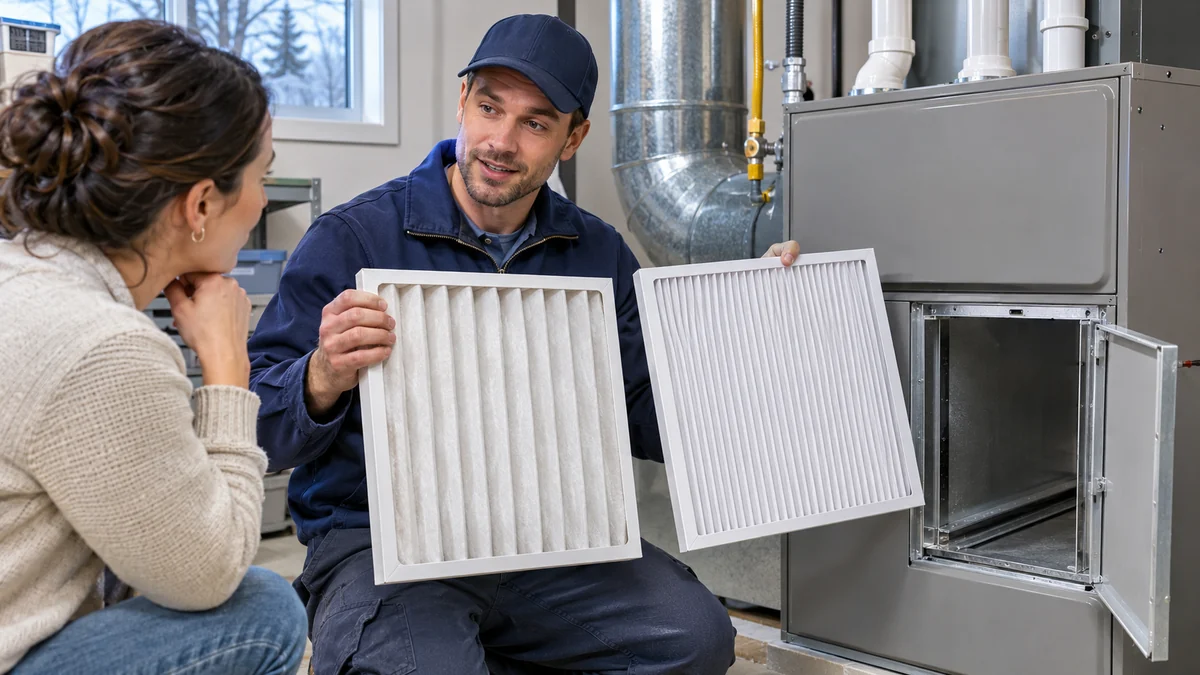
MERV describes how effectively a filter captures particles in defined size ranges. It does not tell you whether the filter fits your cabinet, how much resistance it adds, whether air bypasses around it or how often it should be changed in your home.
Quick answer
Choose a filter that seals properly and is approved for the system. Higher-efficiency media can capture smaller particles, but a restrictive filter in an undersized rack can reduce airflow. Filter depth, surface area, furnace blower capability and the home's actual particle problem all matter.
What a MERV rating tells you
The Minimum Efficiency Reporting Value is a standardized particle-filtration rating. A higher number generally indicates greater capture efficiency for smaller particles. It does not mean the filter removes gases, carbon monoxide or every odour. It also does not convert a furnace into a balanced ventilation system.
| MERV | 0.3–1.0 µm | 1.0–3.0 µm | 3.0–10.0 µm |
|---|---|---|---|
| 8 | No minimum rating | At least 20% | At least 70% |
| 9 | No minimum rating | At least 35% | At least 75% |
| 10 | No minimum rating | At least 50% | At least 80% |
| 11 | At least 20% | At least 65% | At least 85% |
| 12 | At least 35% | At least 80% | At least 90% |
| 13 | At least 50% | At least 85% | At least 90% |
The table summarizes ASHRAE Standard 52.2 performance bands. It describes minimum capture efficiency at the test airflow; it does not predict the pressure drop of a particular product or guarantee how much of a pollutant will be removed from a specific room.
Which MERV rating should a home use?
| Goal | Reasonable starting discussion | Compatibility check |
|---|---|---|
| Equipment protection and larger household dust | Use the manufacturer-approved filter, commonly within the lower residential MERV range | Correct dimensions, firm fit and no bypass around the frame |
| Better capture of pollen and smaller household particles | Consider MERV 8–11 if the equipment and filter area support it | Manufacturer documentation, filter depth, pressure drop and measured airflow |
| Wildfire-smoke preparation | Health Canada identifies MERV 13 or higher where feasible, often supplemented with a properly sized portable cleaner | Do not install dense media that causes unacceptable airflow or equipment operation |
| Odours, VOCs or carbon monoxide | A MERV upgrade is not the primary solution | Control the source, ventilate appropriately and use certified CO alarms |
This is a decision framework, not a universal prescription. Begin with the furnace or air-handler manual and the cabinet label. If they do not state an allowable filter, have the system assessed before moving to denser media.
Why filter thickness and cabinet design matter
A deeper media filter usually has more surface area than a thin filter of the same face size. More area can allow useful filtration with a lower pressure drop, although the actual performance depends on the product and airflow. Retrofitting a media cabinet may be better than forcing dense one-inch media into a rack that was not designed for it.
MERV, MPR and FPR are not the same scale
MERV is the standardized rating used in this guide. MPR and FPR are proprietary retail rating systems, and a universal exact conversion should not be assumed. Look for the stated MERV rating on the product documentation and compare the filter's dimensions, depth and pressure information—not only the largest marketing number on the package.
Signs the filter or rack needs attention
- The filter collapses, whistles or is pulled out of shape.
- Dust streaks show air bypassing around the frame.
- Supply airflow becomes noticeably weaker after a filter change.
- The furnace overheats, cycles on limit or the cooling coil freezes.
- The installed size does not match the rack or cabinet label.
These symptoms do not prove the filter is the only problem. Dirty coils, closed registers, duct restrictions and blower settings can create similar airflow concerns.
How often should a furnace filter be changed?
Follow the manufacturer and inspect the filter rather than relying on one universal calendar. Occupancy, pets, renovation dust, fan runtime, smoke events and filter area all affect loading. A thin filter may require attention much sooner than a large media filter. Record the installation date and examine both the filter and system performance.
A five-step filter decision
- Write down the exact cabinet dimensions and current filter model.
- Check the equipment manual or approved filter specification.
- Name the problem you are trying to reduce: larger dust, pollen, fine smoke particles or something a particle filter cannot address.
- Choose the highest useful efficiency the system can support with the available media area and airflow.
- After installation, confirm the filter seals properly and watch for weaker airflow, unusual noise, overheating or cooling-coil icing.
MERV 13 and smoke preparation
Health Canada recommends higher-efficiency filtration such as MERV 13 where the system can accommodate it for smoke and other fine particles. “Where feasible” is important. A technician can measure pressure and airflow, confirm the rack and determine whether a cabinet or blower adjustment is needed.
Patterson Mechanical provides HVAC air filtration systems for Manitoba homes. Compare central filtration with room equipment in our guide to whole-house air cleaners and portable HEPA units, or return to the Manitoba indoor-air-quality guide.
Not sure which filter your system can support?
We can check the cabinet, filter fit, pressure and airflow before you move to denser media or install a larger whole-home filtration cabinet.
Request ServiceFrequently Asked Questions
Is a higher MERV rating always better?
No. Higher efficiency can improve particle capture, but the furnace or air handler must maintain proper airflow through the filter and cabinet.
Can I put a MERV 13 filter in any furnace?
Not automatically. Confirm the manufacturer's guidance, filter area, rack design, blower capability and measured pressure before upgrading.
Does a furnace filter remove wildfire smoke?
A compatible higher-efficiency filter can reduce fine smoke particles, especially with adequate fan runtime. Portable HEPA cleaning can add room-level support.
Why is there dust around the edge of my filter?
The filter may be the wrong size, the rack may not seal, or air may be bypassing around the frame instead of passing through the media.
Will a better filter remove odours?
Particle filters do not remove every gas or odour. Source control, ventilation and properly designed gas-phase media may be needed.