
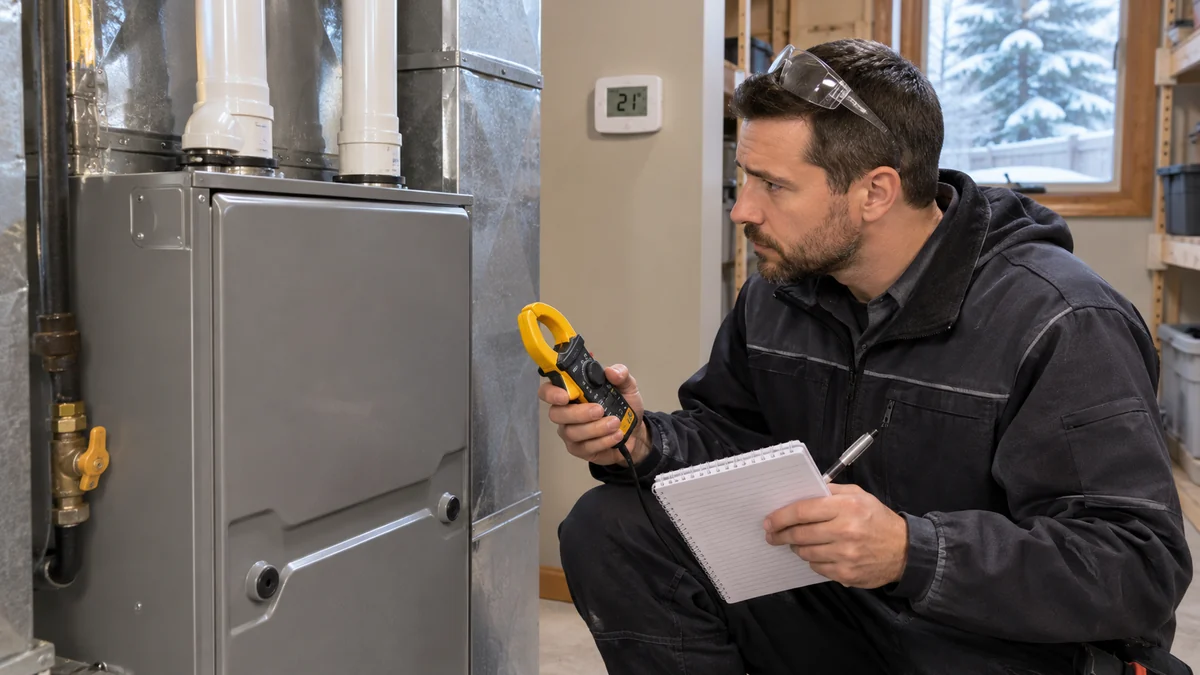
Furnace short cycling is repeated startup and shutdown without a normal, useful heating cycle. The cause can be as simple as a thermostat location or loaded filter, but it can also involve overheating, ignition, flame proving, venting, condensate, controls or equipment sizing.
What to do first
Time two or three cycles, record where the sequence stops, check the thermostat setting and visible filter, and photograph the fault code. Do not keep resetting the furnace or bypass a limit, pressure switch or door switch.
Confirm that the cycling is actually abnormal
Cycle length changes with outdoor temperature, heat loss, thermostat control strategy and whether the furnace has single-stage, two-stage or modulating heat. A system may run for long periods during severe cold. Short cycling is different: the unit repeatedly starts and stops before delivering stable heat, often with the room remaining below setpoint.
Record the thermostat temperature, outdoor conditions, time from startup to shutdown, time before restart and whether the blower, inducer and burners each operate. Those observations are more useful than a general statement that the furnace “runs too much.”
Use the stopping point to narrow the direction
| Cycle pattern | Possible direction | Evidence to preserve |
|---|---|---|
| Stops before ignition | Pressure proving, venting, igniter, control or condensate safety | Code, recent snow or water, startup sounds |
| Flame starts, then stops within seconds | Flame sensing, gas delivery or control issue | Exact timing and code |
| Runs several minutes, then burner stops while blower continues | Airflow restriction or high-limit trip | Filter, open grilles and cycle timing |
| Room reaches setpoint very quickly, then restarts soon | Thermostat location, control settings or oversized equipment | Room temperatures and affected areas |
| Cycles only during blowing snow or deep cold | Vent blockage, intake condition, condensate or marginal system fault | Weather and exterior vent condition |
Airflow restriction and high-limit cycling
A loaded filter, blocked return, closed registers, dirty blower, restricted coil or inadequate ductwork can cause excessive furnace temperature. The burner shuts off on limit while the blower removes heat, then the sequence repeats after the unit cools. A correct filter and open grilles are homeowner-safe checks; measuring temperature rise and static pressure belongs to a technician.
Higher filter efficiency is not automatically better if the cabinet and blower cannot support the resistance. Our MERV and furnace-filter guide explains the tradeoff.
Ignition, flame and venting cycles
If the flame appears briefly and goes out, the furnace may not be proving flame or maintaining safe combustion. If ignition never occurs, the sequence may be stopping earlier at venting, pressure, ignition or control. High-efficiency units can also lock out when intake/exhaust flow or condensate drainage is not correct.
Do not polish sensors, adjust burners or force switches based on an online guess. Similar timing can have different causes, and gas-fired equipment requires measured diagnosis.
Thermostat placement and equipment sizing
A thermostat near a supply register, exterior door, fireplace or strong sun can satisfy or call for heat unrepresentatively. Loose wiring or an incompatible control strategy can also create erratic calls. Equipment that is materially oversized may warm the thermostat area quickly without providing even comfort through the house.
Sizing should be reviewed with heat-loss information and duct capacity, not judged from cycle length alone. If short cycling is part of a larger replacement decision, use our furnace repair-versus-replacement framework.
What a defensible diagnosis includes
- Fault-code history and startup sequence
- Thermostat demand and placement
- Filter, return and supply restrictions
- Temperature rise and total external static pressure
- Ignition and flame-proving operation
- Venting, pressure and condensate condition where applicable
- Equipment capacity relative to the home and duct system
Patterson Mechanical provides furnace short-cycling diagnosis and repair in Manitoba. The goal is to identify the safety or control that ends the cycle and the condition that caused it—not simply clear the code until it returns.
Furnace starting and stopping too often?
Time the sequence and save the fault code. We can test the airflow, controls, ignition and venting conditions that are ending the cycle.
Request Furnace ServiceFrequently Asked Questions
How short is too short for a furnace cycle?
There is no universal minute threshold. Repeated starts and stops before stable heat is delivered, especially while the room remains below setpoint, deserve diagnosis.
Can a dirty filter cause short cycling?
Yes. Restricted airflow can raise furnace temperature and open the high limit. Replace a visibly loaded filter with the correct type, but call if cycling continues.
Does short cycling mean the furnace is too large?
Oversizing is one possible cause, but airflow, thermostat, ignition, flame, venting and control faults are also common. Measurements are needed before concluding the furnace is oversized.
Can I keep resetting a short-cycling furnace?
No. Repeated resets can erase fault history and force another failed sequence. Record the code and arrange diagnosis when the fault repeats.
Is short cycling dangerous?
Some causes are operational; others involve combustion, overheating or electrical faults. Shut down and get urgent help for gas odour, a CO alarm, smoke, scorching or repeated breaker trips.