
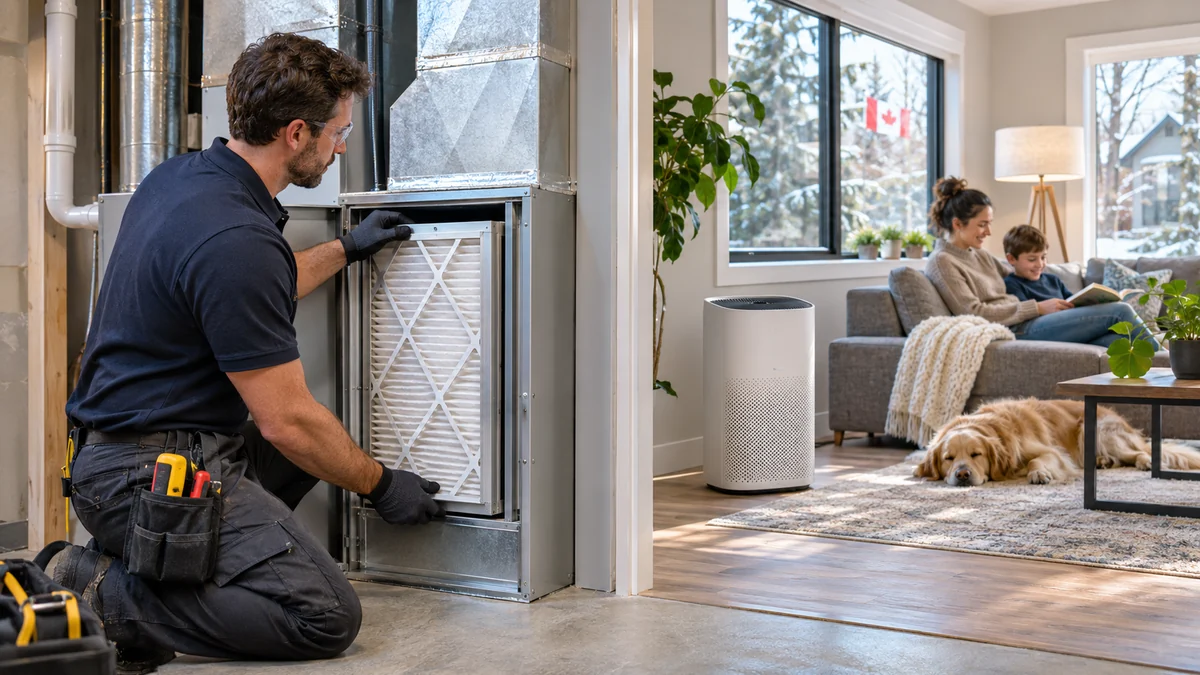
The right air cleaner depends on the contaminant, rooms that matter most, HVAC configuration, noise tolerance and maintenance commitment. “Whole-house” and “HEPA” describe different things: coverage and filter performance are not interchangeable.
Quick comparison
A central media cleaner filters air whenever the HVAC fan moves it. A portable HEPA unit can provide strong particle cleaning in one room when sized by CADR. Neither substitutes for source control, moisture repair, ventilation or carbon-monoxide protection.
| Option | Best use | Main limitation |
|---|---|---|
| Standard furnace filter | Protecting equipment and basic particle reduction | Performance depends on rating, fit and fan operation |
| Deep central media filter | Whole-system particle filtration with more media area | Requires compatible cabinet, pressure and airflow |
| Electronic or specialty central cleaner | Selected particles or gases when properly designed | Maintenance and by-product specifications vary |
| Portable HEPA cleaner | Focused cleaning in a bedroom or main living room | Does not automatically clean every room |
How central filtration works
Central filtration treats return air before it reaches the furnace, air handler or cooling coil. Coverage depends on the duct system and fan runtime. A well-sealed media cabinet can provide more surface area than a thin filter and may support higher efficiency with less restriction. Rooms with weak return airflow may receive less benefit.
How portable HEPA cleaning works
A portable unit pulls room air through a high-efficiency filter. Health Canada recommends choosing by clean air delivery rate, or CADR, and notes that smoke CADR should generally be at least two-thirds of the room's square footage for an eight-foot ceiling. Higher speed and longer runtime clean more air but can create more noise.
For example, a 10-by-12-foot room has 120 square feet of floor area, so Health Canada's general smoke-sizing guideline points to a smoke CADR of at least 80. Higher ceilings, open doorways and adjoining spaces increase the amount of air the unit must handle. Size for the actual room where the cleaner will operate rather than the home's total floor area.
What about odours and VOCs?
HEPA and MERV ratings describe particle performance, not gas removal. Activated carbon or other sorbent media may reduce selected gases, but capacity and performance vary and there is no simple universal rating comparable to particle CADR. Remove the source and ventilate with clean outdoor air when conditions allow.
Avoid ozone-producing devices
Health Canada advises against ozone generators in homes. Ozone is a lung irritant and should not be introduced as an indoor-air treatment. For electronic cleaners, review independent ozone-emission testing and maintenance requirements rather than relying on marketing names.
When using both makes sense
A compatible central filter can provide broad baseline filtration, while a portable HEPA unit can add higher clean-air delivery where a person spends the most time. This combination is especially useful when the central system cannot accept a much more restrictive filter or when smoke protection is needed in a designated room.
Compare maintenance before buying
Every cleaner loses performance when its filter loads. Compare replacement-filter availability, annual media cost, noise at the speed you will actually use and the effort required to clean pre-filters or electronic cells. A central cleaner also depends on a sealed cabinet and a blower schedule that moves air through it. A portable unit should have enough clear space around its intake and outlet. If replacement media is difficult to source or the unit is too loud to run, its laboratory rating will not translate into useful day-to-day cleaning.
Use this buying checklist
- Contaminant: decide whether the goal is dust, pollen, smoke particles, odour or a moisture problem.
- Coverage: choose whole-system baseline filtration, focused room cleaning or both.
- Performance: compare MERV and pressure data for central media, or certified smoke CADR for a portable cleaner.
- Usability: compare noise at the intended speed, energy use, controls and safe placement.
- Ownership cost: confirm replacement-filter price and availability before buying the device.
Patterson Mechanical installs and services whole-house air purification systems. Before selecting equipment, review our MERV filter guide and the broader indoor-air-quality framework.
Comparing central and room air cleaning?
Tell us the particle problem, priority rooms and existing HVAC setup. We can help determine whether central filtration, portable cleaning or a combined approach makes sense.
Request ServiceFrequently Asked Questions
Is a portable HEPA cleaner better than a furnace filter?
It serves a different area. A portable HEPA unit can clean one room intensively, while a central filter treats air moving through the duct system.
Can one portable air cleaner clean the entire house?
Usually not evenly. Select it for the room size and keep doors and placement consistent with the manufacturer's instructions.
Does HEPA remove smells?
HEPA captures particles, not all gases. Carbon media may help selected odours, but source control and ventilation remain important.
Should I run the furnace fan continuously for filtration?
More fan runtime increases central filtration, but electricity use, blower type, noise and system design matter. Ask how your equipment is intended to operate.
Are ozone air cleaners safe?
Health Canada advises against ozone generators in homes because ozone can harm health.