
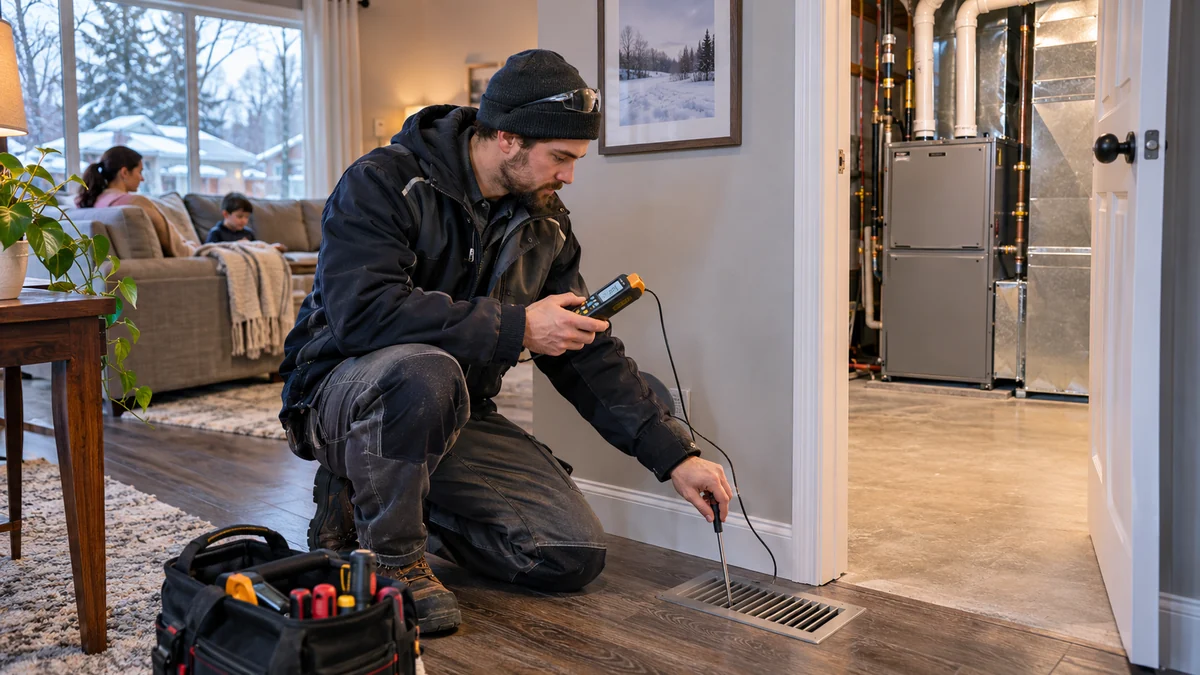
A furnace may push a short burst of cool air while cold ductwork clears at startup or after the burner shuts down. It is not normal for the blower to run through an entire heat call without the air becoming warm, or for the room temperature to keep falling.
Quick distinction
Usually normal: cool air for a short period at the beginning or end of a cycle. Needs attention: continuous cool air, repeated warm-cold changes, a falling room temperature, a fault code, gas odour, a CO alarm or a burner that will not stay on.
Start with the thermostat fan setting
Set the thermostat to Heat and the fan to Auto. With the fan set to On, the blower may circulate room-temperature air between burner cycles. That can feel cold against skin even though it is not refrigerated air. Changing to Auto should make the blower follow normal heating cycles unless the furnace has a separate continuous-circulation setting.
If the thermostat is battery-powered, replace weak batteries according to its instructions. Do not move unfamiliar wiring or bypass a thermostat to force a heat call.
Match the air pattern to the likely system stage
| Pattern | What it may indicate | What to record |
|---|---|---|
| Cool briefly, then consistently warm | Normal duct purge and warm-up | Approximate delay before warm air |
| Blower runs continuously; heat comes and goes | Fan set to On or burner cycling off | Thermostat fan setting and cycle timing |
| Warm for a minute, then cool | Burner shuts down while blower continues | Error code and whether the filter is loaded |
| Never becomes warm | No ignition, failed flame proving, gas/control or safety fault | Startup sounds and displayed code |
| Warm at furnace, cool at distant rooms | Duct heat loss, leakage or airflow imbalance | Which rooms and registers are affected |
Why airflow restriction can create cold-air cycles
A dirty or overly restrictive filter, blocked return grille, closed supply registers or a dirty blower can reduce airflow through the heat exchanger. The furnace may reach its temperature limit, stop the burner and keep the blower running to cool itself. The result can alternate between warm and cool air.
Replace a visibly dirty filter with the correct size and supported efficiency. Open normal supply and return grilles and move furniture away from them. Do not remove the filter and continue operating as a permanent test. For filter selection, see our Manitoba furnace-filter guide.
Ignition, flame and safety faults need diagnosis
Modern furnaces must complete several safety steps before and during burner operation. An igniter, gas valve, flame sensor, pressure switch, limit or control fault can stop heat while the blower continues. A blocked vent or condensate problem can also prevent safe operation in a high-efficiency furnace.
Do not clean burners, adjust gas pressure, bypass a switch or repeatedly reset the furnace. Photograph the code and note whether the burners appear to start and stop only if that can be observed through a normal viewing port without removing panels.
When the duct system is losing the heat
If air is warm near the furnace but much cooler or weaker in distant rooms, the furnace may be producing heat that the distribution system is not delivering. Disconnected ducts, leakage, poor insulation through cold spaces, inadequate returns and balancing problems can all affect comfort. Our guide to uneven heating and cold rooms separates equipment, duct and envelope clues.
Patterson Mechanical provides furnace repair and combustion-safe diagnosis in Manitoba. In Winnipeg homes, note whether the problem is limited to an addition, finished basement or upper floor; that pattern can help distinguish equipment output from altered ductwork. See our Winnipeg furnace and HVAC service area.
Call urgently for these warning signs
- A carbon-monoxide alarm sounds or occupants develop unexplained headache, nausea or dizziness.
- There is a persistent natural-gas odour.
- The furnace makes a loud bang, shows soot or repeatedly fails ignition.
- The breaker trips, wiring smells hot or water reaches electrical components.
- Indoor temperature is dropping quickly in dangerous cold.
Leave for a suspected gas or CO emergency and contact emergency or utility help from a safe location. Cold air alone is not proof of a gas leak, but it is a reason to stop repeated restart attempts and obtain a diagnosis.
Is the blower running without reliable heat?
Record the thermostat setting, filter condition, cycle timing and any code. We can determine whether the fault is in heat production, airflow or distribution.
Request Furnace ServiceFrequently Asked Questions
Is it normal for a furnace to blow cold air when it first starts?
A short burst can be normal while the blower clears cool duct air. The supply should become warm and the room temperature should stabilize during the cycle.
Why does the furnace blow warm air and then cold air?
The burner may be shutting down while the blower continues because of a fan setting, airflow limit, ignition or flame-proving fault, venting issue or control problem.
Can a thermostat make the furnace blow cold air?
Yes. A fan set to On circulates air between heat calls, and a thermostat or wiring problem can prevent a correct heating demand. Do not bypass wiring to test it.
Should I turn the furnace off if it blows cold air?
Turn it off and call when the house is losing temperature, the unit repeatedly fails, or there are safety signs. A brief startup draft alone does not usually require shutdown.
Can leaky ducts make heated air feel cold?
Yes. Ducts through unheated spaces can lose heat, and leaks can reduce delivery to distant rooms. Airflow and temperature measurements help confirm the distribution problem.