
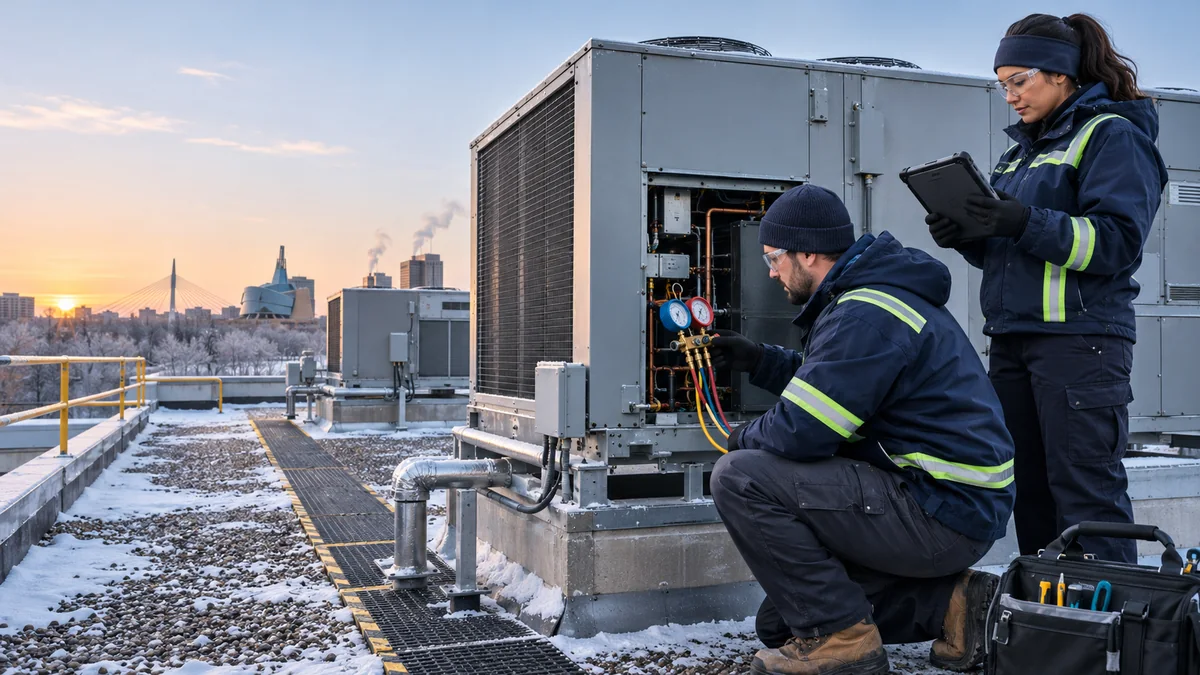
Commercial HVAC maintenance should do more than replace filters. A strong program documents what equipment exists, how it performs, which deficiencies are developing and which repairs should be completed before the next peak season.
Core checklist
Maintain an equipment register, schedule heating and cooling inspections, track filter and belt changes, verify controls and safeties, clean heat-transfer surfaces, inspect drainage and document condition with priorities.
Build the equipment register first
List each rooftop unit, make-up air unit, boiler, pump, exhaust fan, split system and control point. Record location, model, serial, age, fuel, filter size, service history and the area served. Without an inventory, recurring tasks are easily missed.
Fall heating-season tasks
- Verify ignition, safeties, combustion and venting.
- Inspect heat exchangers, burners and gas trains as applicable.
- Check belts, bearings, motors and electrical connections.
- Test freeze protection, low-temperature alarms and boiler controls.
- Confirm outside-air dampers and exhaust systems operate correctly.
Spring cooling-season tasks
- Clean coils and confirm unobstructed airflow.
- Inspect refrigerant circuits and operating temperatures.
- Clear condensate drains and verify traps.
- Test economizers, dampers and building controls.
- Check roof penetrations and equipment curbs for visible concerns.
Tasks throughout the year
- Change filters based on conditions and pressure drop, not only the calendar.
- Investigate occupant complaints by zone and time.
- Trend energy use, runtimes and repeated alarms.
- Document temporary repairs and assign a completion date.
- Keep outdoor equipment clear of snow, vegetation and stored materials.
Turn findings into a capital plan
Label findings as immediate safety/operational issues, near-term repairs and longer-term renewal. This helps owners budget before failure and coordinate HVAC work with roofing, electrical or tenant projects.
Patterson Mechanical offers commercial HVAC maintenance programs and broader commercial HVAC services in Manitoba for property owners and facilities teams.
Natural Resources Canada notes that regular cleaning, controls and correct system operation affect commercial boiler and HVAC efficiency. Health Canada also emphasizes ventilation and filtration as part of indoor-air management in office buildings.
Assign ownership and document completion
A checklist only works when every task has an owner, a due date and a record. Separate items that building staff can safely observe—such as unusual noise, occupied-space complaints or blocked outdoor equipment—from work that belongs to a qualified HVAC technician. Store service reports, filter specifications, belt sizes, control setpoints and photos under the equipment ID used in the asset register.
Review the log after each heating and cooling season. Repeated alarms, comfort complaints, refrigerant-related repairs, motor failures or emergency calls may point to a larger control, airflow or equipment problem. Trend information also helps management distinguish a maintenance expense from a capital replacement project.
Include indoor-air and operating context
Maintenance planning should account for occupancy, operating hours, renovation dust, outdoor-air requirements and spaces with special temperature or humidity needs. When usage changes, schedules and ventilation settings may need review instead of simply extending equipment runtime. Coordinate changes with the building's controls and qualified service providers.
Commercial HVAC maintenance schedule
Use this as a planning framework, then adjust it for equipment manufacturers, occupancy, operating hours, environment and the findings from each service visit. Building staff should handle observations only; electrical, refrigeration, combustion and safety work belongs to qualified technicians.
| Frequency | Building-staff observations | Qualified service tasks |
|---|---|---|
| Monthly | Review comfort complaints, alarms, unusual noise, visible leaks and blocked outdoor equipment | Change filters when condition or pressure drop requires it; address active deficiencies |
| Quarterly | Confirm schedules still match occupancy and record meter or runtime changes | Inspect belts, bearings, motors, drains, dampers, sensors and control trends as applicable |
| Before cooling season | Verify occupied-space complaints and roof access needs | Clean coils, test refrigeration operation, clear condensate systems and commission economizers |
| Before heating season | Confirm freeze-sensitive areas and alarm contacts | Inspect heat exchangers, burners, ignition, safeties, venting and freeze protection |
| Annually | Review the asset register, repair history and capital plan | Complete equipment-specific inspection, control verification and documented condition assessment |
Checklist by equipment type
| Equipment | Important checklist items |
|---|---|
| Rooftop and make-up air units | Filters, belts, bearings, dampers, coils, drains, gas heat, safeties, curb and visible roof concerns |
| Boilers and hydronic systems | Combustion, venting, water pressure, expansion, pumps, strainers, leaks, controls and freeze protection |
| Split, heat-pump and VRF systems | Coils, refrigerant circuit, condensate, fans, electrical components, controls and low-temperature operation |
| Exhaust and ventilation | Fans, belts, guards, dampers, make-up air relationship, outdoor-air intake and operating schedule |
| Building controls | Schedules, setpoints, overrides, alarms, sensor accuracy, trend logs and unresolved temporary changes |
Maintenance records and KPIs
Track emergency calls, repeated alarms, comfort complaints by zone, filter pressure drop, runtime, energy use, temporary repairs and recurring component failures. Useful records include the equipment ID, date, readings, work completed, parts used, photos, deficiency priority, responsible person and target completion date. These trends turn maintenance reports into a defensible repair and capital budget.
Health Canada recommends regular HVAC inspection and maintenance as part of office indoor-air management. Schedule intrusive cleaning or shutdown work when disruption and contaminant exposure can be controlled.
Need help with this system?
Patterson Mechanical serves Stonewall, Winnipeg and Manitoba's Interlake region. We will confirm service availability and an appointment window for your property.
Request ServiceFrequently Asked Questions
How often should commercial HVAC equipment be serviced?
Many buildings schedule qualified service before heating and cooling seasons, with monthly or quarterly checks between visits. Equipment, occupancy and manufacturer requirements determine the final frequency.
What belongs in a commercial HVAC service report?
Include the equipment ID, readings, work completed, parts, photos, deficiencies, priority, responsible party and target completion date.
Who should complete the maintenance checklist?
Building staff can record observations and alarms. Qualified technicians should handle refrigeration, combustion, electrical, control and safety testing.
Can preventive maintenance eliminate breakdowns?
No. It reduces avoidable failures and improves planning, but components can still fail. Trend records and contingency plans remain important.
Should rooftop units be replaced together?
Not automatically. Compare condition, reliability, controls, roof work, tenant disruption and capital timing for each unit and the system as a whole.