
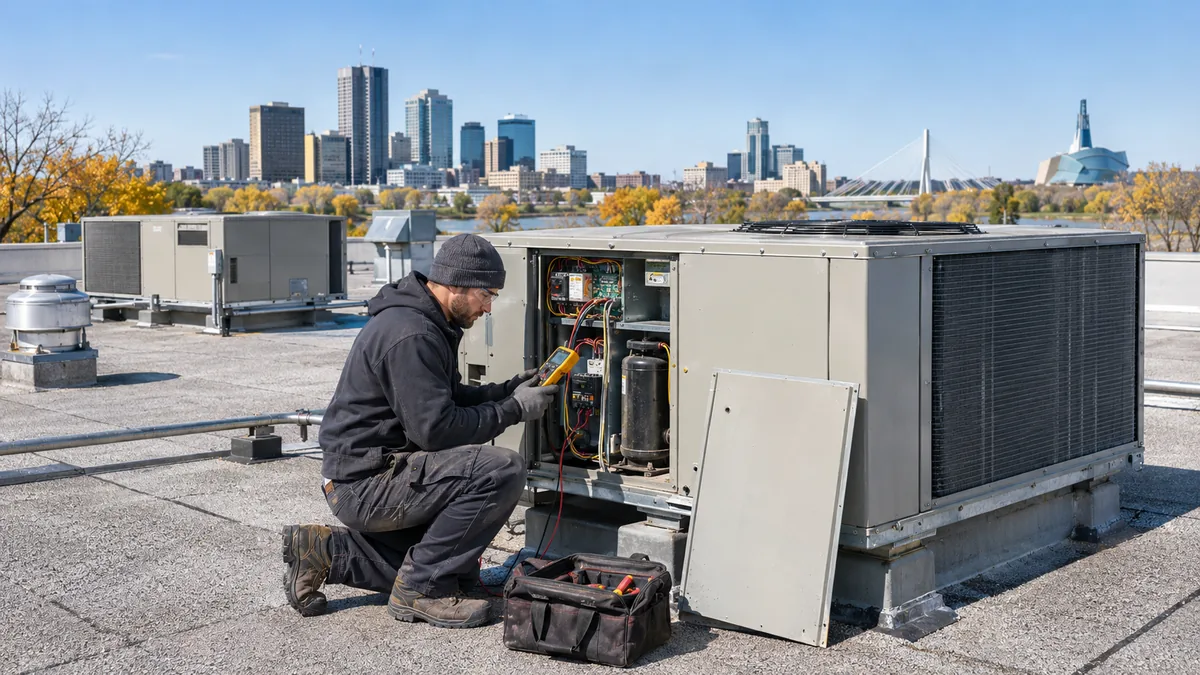
Packaged rooftop units combine heating, cooling, ventilation and controls in one weather-exposed cabinet. That makes them practical for many commercial buildings, but it also means one neglected belt, blocked drain, failed damper or control fault can affect an entire tenant area.
In short
Start with an equipment register, inspect before both heating and cooling seasons, document operating measurements and separate immediate safety or downtime risks from planned repairs. Building staff can report symptoms and keep access clear; combustion, refrigeration, electrical and internal mechanical work belongs with qualified technicians.
Know what the rooftop unit serves
Record the unit number, make, model, serial number, age, filter size, fuel, area served and control zone. Add roof location, access method and service history. A complaint such as “the store is cold” is much easier to investigate when the affected zone can be matched to a specific unit and schedule.
Patterson Mechanical provides commercial rooftop HVAC service in Manitoba for commercial properties in Stonewall, Winnipeg and surrounding communities.
| Observed problem | Possible directions | Priority |
|---|---|---|
| Weak supply airflow | Loaded filters, belt or blower problem, closed damper, coil restriction or control setting | Prompt assessment if comfort or freeze protection is affected |
| Water near the unit | Blocked drain, failed trap, damaged pan, snow or roof-related entry | Protect the interior and investigate promptly |
| Short cycling | Control, airflow, safety, temperature or refrigeration issue | Do not repeatedly reset; record the pattern |
| One zone is stuffy | Outdoor-air damper, schedule, exhaust balance, sensor or distribution issue | Review occupancy and ventilation as well as temperature |
| Unusual noise or vibration | Belt, bearing, fan, panel or compressor-related problem | Shut down if operation appears unsafe |
Heating-season maintenance priorities
Before sustained cold, qualified service should address the heating section, ignition, safeties, heat exchanger condition, gas train where applicable, venting, blower components and controls. The roof curb, panels, weather seals and drainage also matter because snow and wind can expose cabinet or access problems.
Verify that schedules, setbacks and low-temperature protection reflect actual occupancy. A unit that is intentionally off overnight should not leave plumbing, perimeter spaces or process equipment vulnerable to freezing.
Cooling-season maintenance priorities
Cooling preparation includes clean heat-transfer surfaces, unobstructed condenser airflow, sound electrical components, working condensate drainage and refrigeration measurements interpreted against the equipment specification. An economizer should be checked as a controlled outdoor-air system, not assumed to work because its damper moves.
Filters, belts and coils interact. A new filter does not correct a slipping belt, dirty coil or poor outside-air setting. The existing commercial HVAC preventive-maintenance checklist provides a broader building-level schedule.
What building staff can safely observe
- Record the affected area, time, weather and thermostat condition.
- Note alarms, noise, vibration, odour or visible water without opening energized panels.
- Keep roof access, intake and exhaust areas clear.
- Confirm whether operating hours or tenant use recently changed.
- Preserve service reports under the unit's asset number.
Do not bypass safeties, work inside live electrical sections, handle refrigerant or attempt gas adjustments. If there is smoke, a gas odour, electrical arcing or an unsafe roof condition, stop and follow the building's emergency plan.
Turn repeated service into a capital plan
One isolated repair does not automatically justify replacement. Look for repeated failures, unavailable parts, refrigerant concerns, corroded cabinets, heat-exchanger findings, control incompatibility, poor comfort and the cost of business interruption. Coordinate major replacement with roof work, crane access, electrical capacity, gas service and tenant schedules.
Use our commercial HVAC repair-versus-replacement framework when the same unit is appearing repeatedly in service reports. A commercial mechanical maintenance program can keep the inventory, findings and seasonal work in one documented process.
Download the rooftop-unit asset register
Create one printable record per unit for model data, filters, areas served, access, seasonal findings and service history.
Need a rooftop-unit condition review?
Bring the unit list, service history and problem zones. We can assess the equipment and separate immediate repairs from planned maintenance and renewal work.
Request Commercial ServiceFrequently Asked Questions
How often should a commercial rooftop unit be serviced?
The final schedule depends on the manufacturer, operating hours, occupancy, environment and criticality. Many buildings plan qualified inspections before heating and cooling seasons, with filter and condition checks between visits.
Can building staff change rooftop-unit filters?
Only when the building's procedures, access conditions and equipment design make that task safe. Roof access, energized equipment and incorrect filter installation can create hazards or performance problems.
Why does a rooftop unit serve heat but not cooling?
Heating and cooling use different components and safeties. Controls, refrigeration, condenser airflow, drainage or electrical faults can affect cooling while the heating section still operates.
Should several old rooftop units be replaced together?
Not automatically. Compare each asset's condition, reliability and zone importance, then consider roof work, controls, crane mobilization and disruption when deciding whether to phase or group replacements.
What information helps when requesting rooftop-unit service?
Provide the unit or zone identifier, symptoms, timing, thermostat state, recent work and any alarm or service history. Photos of the equipment label can help identify the exact unit without guessing.