
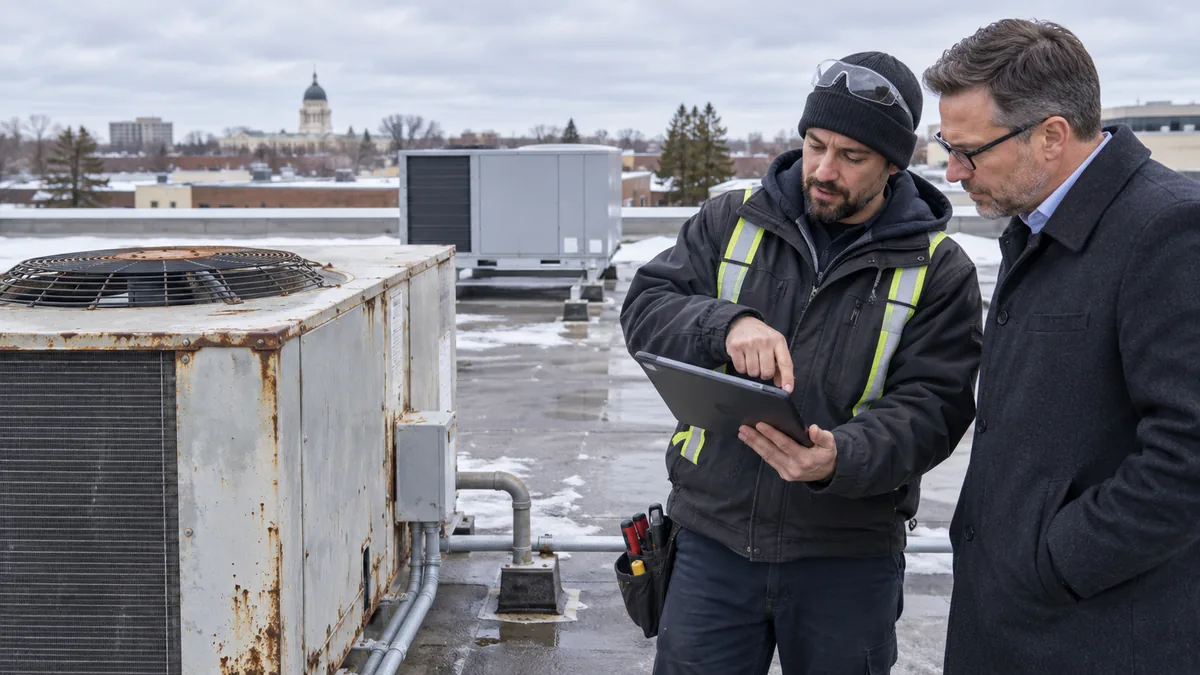
A failed commercial HVAC component creates two questions: what restores operation now, and what choice best manages the next several years? Those are not always the same decision. Repair, retrofit, phased replacement and full replacement can all be reasonable when the diagnosis and business consequences are clear.
Decision summary
Repair when the fault is isolated, the equipment remains supportable and downtime risk is acceptable. Plan replacement when failures repeat, major sections are deteriorating, controls or refrigerant create constraints, or the building no longer receives the capacity and ventilation it needs. Document both the immediate repair and the complete installed replacement scope.
Start with the diagnosed failure
Do not compare a vague repair allowance with an equipment-only replacement price. Identify the failed component, likely cause, related condition findings and what the repair does—and does not—resolve. A motor failure caused by a loaded coil or airflow problem requires a different decision than ordinary component wear.
Patterson Mechanical provides commercial HVAC repair and replacement within its Manitoba service area.
| Option | When it can fit | Main question |
|---|---|---|
| Repair | Isolated, supportable fault on otherwise serviceable equipment | Does the repair address the root cause and restore reliable operation? |
| Retrofit or controls upgrade | Core equipment remains sound but a defined subsystem limits operation | Will new components integrate safely with the existing system? |
| Phased replacement | Several assets differ in condition or capital must be staged | Can controls, capacities and roof work remain coordinated? |
| Full renewal | System-wide condition, use or coordination makes piecemeal work poor value | Is the complete design and disruption understood? |
Reliability and service history
Review several seasons of reports. Repeated refrigerant work, recurring motor or belt failures, ongoing ignition lockouts, corroded cabinets and repeated emergency calls tell more than age by itself. Note whether different failures share one cause, such as airflow, drainage, voltage, controls or operating schedule.
The rooftop-unit maintenance guide explains the evidence worth recording for packaged equipment.
Business interruption changes the equation
A modest repair can carry a large operational consequence when it affects a restaurant, medical tenant, server area, production process or freeze-sensitive building. Consider the probability and consequence of another failure, access to temporary heat or cooling, parts availability and how quickly a safe repair can be completed.
Capacity, ventilation and changed building use
Replacement should not automatically copy the old nameplate. Tenant density, hours, layout, exhaust, lighting, equipment and envelope changes can alter loads and outdoor-air needs. Conversely, comfort complaints do not prove equipment is undersized; distribution, controls and building pressure may be the actual limit.
Scope beyond the box
A complete proposal may involve the roof curb, structural review, crane access, gas piping, electrical service, controls, drainage, duct transitions, permits and commissioning. Compare who is responsible for each item and how tenant operations will be protected.
Use a written decision matrix
- Record the exact diagnosis and immediate safety or operational need.
- Summarize age, condition, repair history and parts support.
- Define the consequence of failure by area and season.
- Confirm current building use, capacity and ventilation requirements.
- Compare repair, retrofit, phased and replacement scopes.
- Include roof, electrical, gas, controls, permits and disruption.
- Document assumptions, exclusions, warranty and commissioning.
Download the decision worksheet
Compare the diagnosed repair, service history, downtime consequence and complete installed replacement scope in one printable record.
For larger coordinated work, our guide to commercial mechanical design-build explains project responsibilities. A commercial design-build team can help align mechanical scope with the wider project.
Need the repair and replacement scopes compared?
We can document the equipment condition, immediate repair and wider project requirements so the decision is based on the building—not a generic age rule.
Request Commercial ServiceFrequently Asked Questions
Is there a commercial HVAC repair percentage that means replace?
No universal percentage makes the decision. Compare the diagnosed repair with the complete replacement scope, remaining system condition, downtime consequences and expected future work.
Should all rooftop units be replaced at once?
Only when condition, roof coordination, controls, crane access or project economics support grouping them. A condition-based phased plan is often more defensible.
Can controls be upgraded without replacing the equipment?
Sometimes. Compatibility, sensors, actuators, sequence, communications and remaining equipment condition must be evaluated as one system.
Does newer equipment guarantee lower operating costs?
No. Selection, controls, installation, schedules, maintenance and the building load all influence use. Avoid savings claims that are not based on the property.
What should a replacement proposal include?
It should define equipment, capacity basis, demolition, curb and duct work, electrical and gas scope, controls, drainage, permits, access, commissioning, warranty and exclusions.