
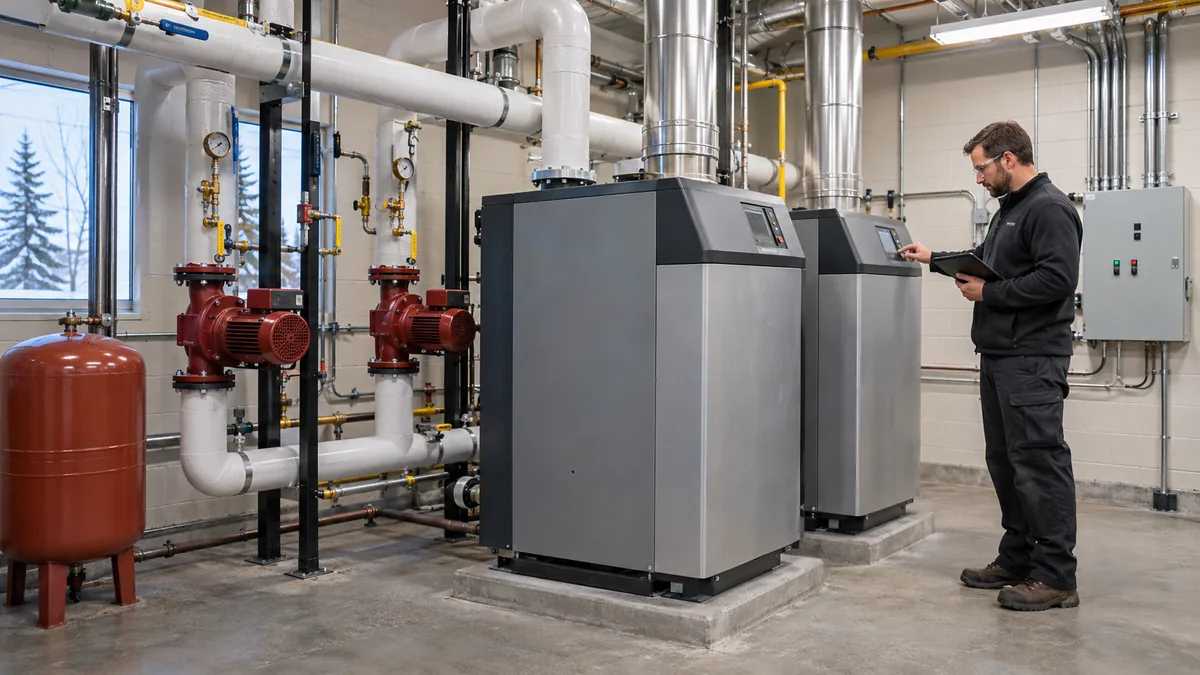
A commercial boiler can fire normally while the building still has cold zones, noise, pressure problems or high operating costs. A useful maintenance plan therefore covers the entire hydronic system: the heat source, pumps, water, expansion, controls, distribution and terminal equipment.
In short
Maintain an asset register, arrange qualified service before the heating season, test the safety and combustion systems, inspect pumps and distribution, review water condition and document operating readings. Never treat a boiler-room checklist as permission to adjust gas, combustion or safety controls without the required qualifications.
Build the boiler-room record
List each boiler, burner, pump, expansion tank, heat exchanger, water-treatment component and control panel. Record the equipment served, design temperatures where known, fuel, age, manuals, inspection history and open deficiencies. Keep the shutdown procedure and emergency contacts accessible to authorized staff.
Patterson Mechanical provides commercial boiler service in Manitoba, including installation and service for commercial hydronic systems within its service area.
| Area | Maintenance question | Useful record |
|---|---|---|
| Boiler and burner | Are ignition, combustion, venting and safeties operating correctly? | Combustion and service report |
| Pumps | Are flow, noise, seals and operation consistent? | Operating status and repair history |
| Water side | Is there evidence of scale, corrosion, air or leakage? | Water-treatment and make-up-water records |
| Controls | Do staging, reset, schedules and zones match building use? | Setpoints, alarms and trend notes |
| Distribution | Are some zones cold, hot or noisy? | Complaint map by zone and time |
Qualified heating-season service
Before peak cold, qualified service should inspect the boiler and burner according to the manufacturer's instructions and applicable requirements. This can include ignition, flame safeguard, limits, low-water protection where present, gas train, combustion, heat-transfer surfaces, breeching and venting. Findings should be recorded rather than reduced to a generic “checked” entry.
Do not bypass a limit, reset a lockout repeatedly or adjust combustion based on flame appearance alone. Gas odour, flue-gas concerns, water near energized equipment or a safety-device failure requires the building's emergency procedure and qualified assessment.
Pumps, expansion and air removal
Circulators and larger pumps move heat through the building. Noise, vibration, seal leakage, high temperature or a zone that never warms can point toward flow, control or distribution problems. Expansion tanks and air-removal components help manage pressure and entrained air; symptoms elsewhere can originate in the mechanical room.
Track static and operating pressure only when the system's expected range is known. Adding water repeatedly is not routine maintenance—it can introduce oxygen and may conceal a leak or expansion problem.
Water condition matters
Scale reduces heat transfer, while corrosion products can restrict strainers, valves and small passages. The correct water-treatment strategy depends on the system materials, make-up water, operating temperature and treatment design. Do not add chemicals by guesswork. Preserve testing and treatment records with the boiler history.
Controls and building operation
Outdoor reset, staging, lead-lag rotation, schedules and zone controls should reflect how the building is actually used. A tenant improvement or operating-hour change can make an old sequence inappropriate even when every component still works. Review alarms and repeated manual overrides; they are evidence, not clutter.
Warning signs that deserve prompt attention
- Gas or combustion odour, soot or repeated ignition lockouts
- Water leakage, falling pressure or frequent make-up water
- Banging, pump cavitation, strong vibration or new mechanical noise
- Cold zones while the boiler runs continuously
- Relief discharge or safety-control faults
- Recurring repairs without a documented root cause
For a symptom-first overview, see our Manitoba boiler troubleshooting guide. Multi-family operators should also review shared boiler and plumbing maintenance in Winnipeg buildings.
Move findings into the capital plan
Classify deficiencies as immediate safety or operational work, near-term reliability repairs and longer-term renewal. Consider burner and control compatibility, venting, redundancy, distribution condition and serviceability—not boiler age alone. A documented commercial maintenance program makes this history easier to defend during budgeting.
Plan boiler work before peak heating demand
We can review the boiler plant, distribution concerns and service history, then document practical maintenance, repair and replacement priorities for the property.
Request Commercial ServiceFrequently Asked Questions
How often should a commercial boiler be serviced?
Follow the manufacturer, inspection requirements and the building's operating conditions. A qualified pre-heating-season service is a common planning point, but some equipment or systems require additional checks.
Is low boiler pressure always a leak?
No. Expansion, fill, gauge and control problems can also affect pressure. Repeated make-up water or visible leakage deserves diagnosis rather than routine topping up.
Why are some zones cold when the boiler is hot?
Possible directions include pump operation, air, valves, controls, balancing, blocked strainers or distribution changes. The symptom does not prove the boiler is undersized.
Does boiler maintenance include water treatment?
Water condition should be reviewed, but treatment is system-specific. Testing, chemical selection and responsibility should be clearly defined rather than assumed.
When should a commercial boiler enter replacement planning?
Begin planning when reliability declines, major components or venting are problematic, capacity no longer fits use, controls are obsolete or repair consequences are becoming unacceptable.