
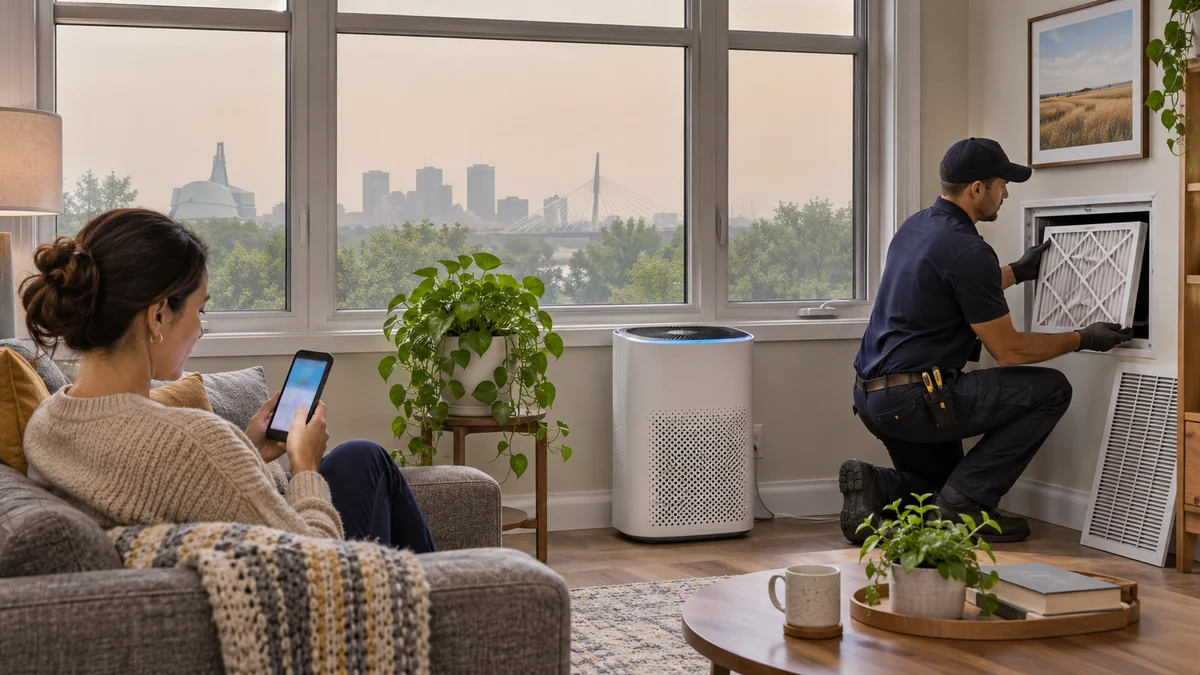
Wildfire smoke can affect Winnipeg even when fires are far away. Fine particles are the main indoor-air concern. Prepare before an advisory so compatible filters and a portable cleaner are available when demand rises.
During a smoke event
Check the Air Quality Health Index, keep windows and doors closed when smoke is present, use air conditioning or recirculation where appropriate, run compatible filtration and reduce indoor particle sources. If the home becomes dangerously hot, cooling and personal safety take priority.
Build a cleaner-air plan before smoke arrives
- Identify one bedroom or living area that can remain closed.
- Select a certified portable cleaner by smoke CADR and room size.
- Confirm the highest-efficiency central filter the HVAC system can support.
- Keep replacement filters available.
- Learn which controls change outdoor-air intake or recirculation.
- Keep certified carbon-monoxide alarms working.
Central HVAC filtration
Health Canada recommends higher-efficiency filtration such as MERV 13 where the system can accommodate it. A dense filter in an unsuitable rack can reduce airflow, so confirm compatibility before smoke season. During smoke, additional fan runtime can move more air through the filter, but blower type, cooling operation and electricity use matter.
Use our MERV filter guide to understand fit, pressure and media area.
Portable HEPA-style air cleaners
Health Canada recommends sizing portable cleaners by clean air delivery rate. As a general guide for an eight-foot ceiling, smoke CADR should be at least two-thirds of the room's square footage. Place the unit where airflow is not blocked, run it longer or faster as needed and replace loaded filters according to instructions.
Different cooling systems need different smoke plans
| Equipment | What it usually does | Smoke-event question |
|---|---|---|
| Central forced air | Moves return air through a central filter | Can the filter cabinet and blower support higher-efficiency media and added runtime? |
| Ductless mini-split | Recirculates room air through a basic equipment filter | Use separate particle filtration; the washable screen is not a substitute for HEPA cleaning |
| Window air conditioner | Cools one room; outdoor-air settings vary | Seal gaps and use recirculation if the unit provides that control |
| Portable air conditioner | Exhausts heat through a hose and may depressurize the room | Check the design and window seal; add a room air cleaner rather than assuming the AC removes smoke |
| Apartment or condo ventilation | May depend on a central building system | Ask building management how outdoor air and filtration are controlled before blocking any vent |
Ventilation changes with outdoor conditions
Normal ventilation removes indoor pollutants and moisture. During heavy outdoor smoke, reduce smoke entry and use recirculation where the system design allows. When the plume passes and outdoor conditions improve, restore fresh-air ventilation so indoor pollutants do not remain trapped. Do not permanently disable an HRV or safety-required ventilation without professional guidance.
Reduce particles produced indoors
Avoid smoking, candles, incense and unnecessary frying during a smoke event. Limit vacuuming unless the machine uses effective filtration. Keep doors and windows closed, but use cooking exhaust when needed for safety. Avoid ozone generators; Health Canada advises against them in homes.
DIY air cleaners are an emergency option with safety limits
Health Canada notes that a do-it-yourself box-fan cleaner may help during a short-term smoke emergency when a ventilation system or certified portable cleaner is unavailable. Use a clean, newer certified box fan with a safety fuse, keep it clear of curtains and furniture, do not use an extension cord and never leave it running unattended or while sleeping. A clogged filter can reduce cleaning and contribute to overheating, so inspect and replace it during the event.
Know when a smoke filter is loading
Keep spare filters before smoke season. During prolonged events, inspect media more often than the normal calendar interval. Replace it according to the equipment instructions when it becomes heavily loaded, airflow falls or the portable cleaner signals a change. A dark-looking filter alone is not a universal end-of-life gauge, but weaker airflow, rising noise or an overheating concern should not be ignored.
Know when the cleaner-air room is not enough
People with heart or lung conditions, older adults, infants and pregnant people may be more affected by smoke. Follow public-health advice and consider relocating to a cleaner, cooler place when indoor smoke remains high, the home overheats or symptoms develop. Filtration is a risk-reduction measure, not a guarantee that indoor air is safe. Keep necessary medication and a plan for transportation available during prolonged events.
Winnipeg-specific preparation
The City of Winnipeg notes that distant fires can affect local air and recommends checking the AQHI, keeping windows closed and considering home filtration. Patterson Mechanical provides whole-home air filtration in Manitoba and HVAC service for Winnipeg homes. We can check filter-cabinet compatibility, airflow and ventilation controls before smoke season.
Compare central and room equipment in our guide to whole-house air cleaners versus portable HEPA units.
Prepare before Winnipeg's next smoke advisory
We can check filter-cabinet compatibility, central airflow and ventilation controls so replacement filters and a cleaner-air plan are ready before outdoor conditions deteriorate.
Request ServiceFrequently Asked Questions
What filter is best for wildfire smoke?
Use the highest-efficiency filter the system can support; Health Canada identifies MERV 13 or higher where feasible. Fit and airflow must remain correct.
Should I turn off my HRV during wildfire smoke?
Follow the system design and local guidance. Outdoor-air intake may need to be reduced during smoke and restored when conditions improve. Do not permanently disable required ventilation.
How large should a portable air cleaner be?
Health Canada suggests a smoke CADR at least two-thirds of room area for an eight-foot ceiling as a general guide.
Can an air conditioner filter wildfire smoke?
A central system can filter recirculated air when equipped with compatible media. Window and portable AC units vary and may not provide meaningful particle filtration.
Are ozone generators useful for smoke?
No. Health Canada advises against ozone generators in homes because ozone can harm health.