
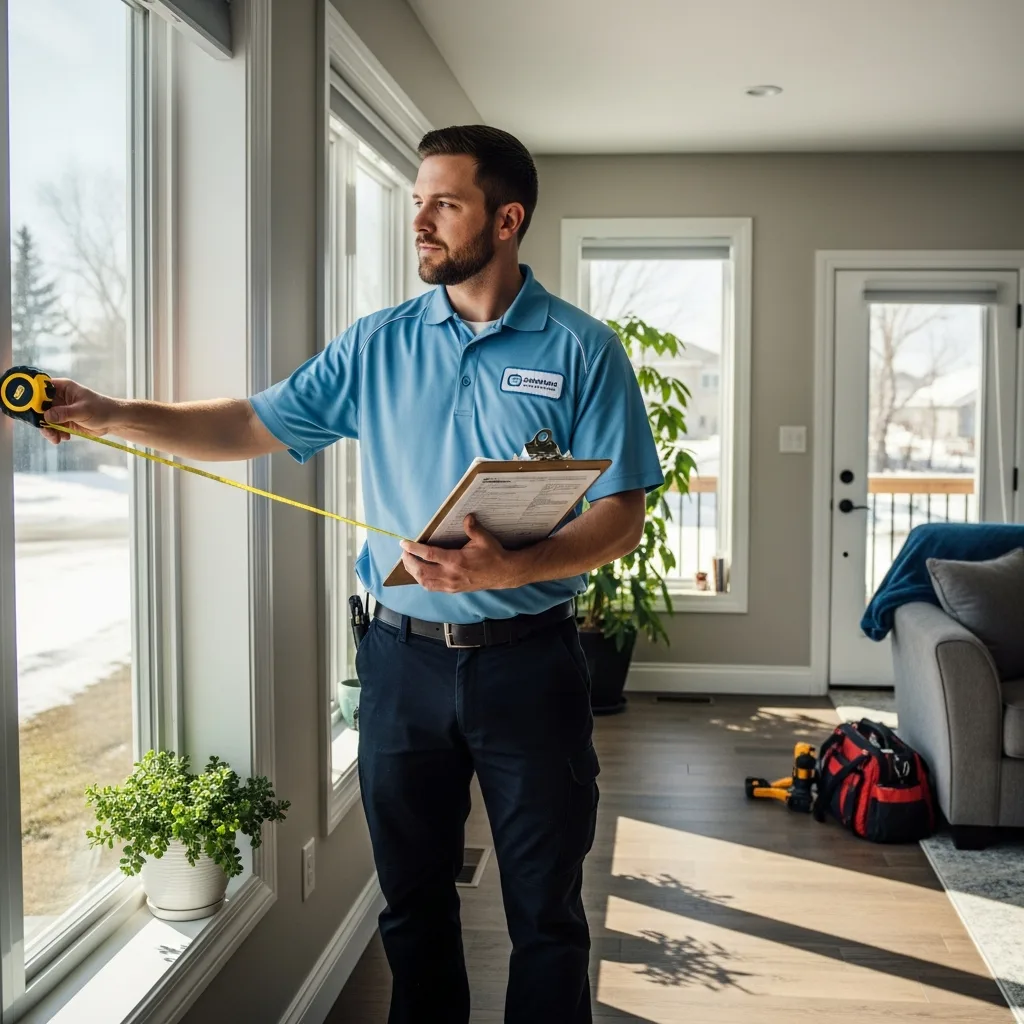
AC sizing affects how well your system cools, how long it lasts, and how much it costs to run. An oversized unit is not "extra cold" — it short-cycles, never runs long enough to remove humidity, and puts more wear on the compressor. An undersized unit runs constantly and can't maintain the set temperature on the hottest days. Both are the wrong answer.
How AC Size Is Measured
Residential air conditioners are sized in tons (refrigeration tons) or BTUs per hour. One ton equals 12,000 BTUs per hour of cooling capacity. Residential systems typically range from 1.5 tons (18,000 BTU) to 5 tons (60,000 BTU), with 2–3 ton systems most common for Manitoba homes in the 1,200–2,200 sq ft range.
The Square-Footage Rule of Thumb
The commonly cited estimate is 20–25 BTU per square foot of conditioned space. By that math:
- 1,200 sq ft home → 24,000–30,000 BTU (2–2.5 ton)
- 1,600 sq ft home → 32,000–40,000 BTU (2.5–3 ton)
- 2,000 sq ft home → 40,000–50,000 BTU (3–4 ton)
- 2,400 sq ft home → 48,000–60,000 BTU (4–5 ton)
These ranges are a starting point, not a final answer. Two homes with identical square footage can have very different cooling loads depending on how they're built.
What the Rule of Thumb Misses
Insulation Quality
A well-insulated newer Manitoba home will have a lower cooling load than an older home with minimal attic insulation and drafty windows of the same size. The attic insulation difference alone can shift the required system size by half a ton.
Window Area and Orientation
Large south- and west-facing windows dramatically increase solar heat gain in summer. A home with extensive glazing on the west side may need significantly more cooling capacity than the square footage calculation suggests.
Ceiling Height
Homes with vaulted ceilings or 9-foot ceilings have more air volume to condition than standard 8-foot ceiling homes of the same floor area. The square footage formula doesn't account for this.
Number of Occupants
Each person in a home generates roughly 250–300 BTU per hour of body heat. A household of six generates meaningfully more internal heat load than a household of two in the same house.
Manual J: The Proper Calculation
The industry standard for residential HVAC sizing is the Manual J load calculation, developed by the Air Conditioning Contractors of America (ACCA). Manual J accounts for all the variables above — insulation R-values, window area and orientation, local climate data, internal heat gains, and duct losses — to determine the actual peak cooling load of a specific home.
A proper Manual J calculation takes more time than a square footage estimate, but it produces a system size that's correct for your specific home rather than an approximation. Any contractor sizing a system without this methodology is guessing, and the consequences show up either on your first hot summer with an undersized system or in elevated energy bills with an oversized one.
For a broader overview of what's involved in a central AC installation, see our central air conditioning guide for Manitoba homeowners. If you're also weighing efficiency tiers, our post on what SEER rating makes sense for Manitoba explains the payback math.
How Sizing Affects Rebate Eligibility
Efficiency Manitoba and federal rebate programs have equipment eligibility requirements — and for heat pumps specifically, some programs require that the system be properly sized to the home. An oversized unit installed primarily to hit a higher BTU specification doesn't serve the homeowner or the rebate program's intent. Our post on HVAC rebates available in Manitoba covers the current eligibility criteria.
The Consequences of Getting It Wrong
Oversized AC
- Short cycling — the system reaches the set temperature quickly and shuts off, then restarts frequently
- Poor humidity control — short run times don't allow the evaporator coil to remove enough moisture from the air
- Higher wear on the compressor from repeated start/stop cycles
- Uneven cooling — some rooms cool quickly, others remain warmer
Undersized AC
- Continuous operation on hot days — the system runs constantly without reaching the set temperature (see our post on why your AC runs constantly)
- Higher energy bills from continuous operation
- Premature compressor wear from continuous duty cycle
- Hot rooms on peak summer days
For central air conditioning in Manitoba, we perform a Manual J load calculation on every new installation. It takes more time upfront, but it means the system we install is sized for your home — not for the next home on our schedule.
If you're deciding between repairing your current system or replacing it with something right-sized, our AC repair vs. replacement guide for Manitoba homeowners walks through the financial decision. If you're also comparing central and ductless options, see our breakdown of ductless vs. central air conditioning in Manitoba.
Get a Properly Sized AC Quote for Your Manitoba Home
We size every system to your specific home using a load calculation — no guesswork. Serving Stonewall, Winnipeg, and the Interlake.
Request a QuoteFrequently Asked Questions
What size central AC do I need for a 1,500 sq ft home in Manitoba?
As a rough starting point, a 1,500 sq ft home in Manitoba would typically require a 2–2.5 ton (24,000–30,000 BTU) system. However, the actual size depends on your home's insulation quality, window area and orientation, ceiling height, and sun exposure. A Manual J load calculation will confirm the right size for your specific home.
What happens if my AC is oversized?
An oversized AC short-cycles — it cools the space too quickly, shuts off, then restarts repeatedly. This causes higher humidity (the system doesn't run long enough to dehumidify properly), uneven temperature distribution, and excess wear on the compressor from frequent start/stop cycles. Bigger is not better when it comes to air conditioning.
How do HVAC contractors calculate what size AC I need?
Reputable contractors use a Manual J load calculation, which accounts for the home's square footage, insulation levels, window area and orientation, ceiling height, local climate data, and internal heat sources. This produces an accurate cooling load figure that determines the right system size. Contractors who size only by square footage are estimating, not calculating.
Does Manitoba's climate affect AC sizing compared to other provinces?
Yes. Manitoba has a continental climate with relatively short but hot and humid summers — design temperatures in the Winnipeg area reach 33–35°C. Calculations use local design temperature data, so a Manitoba home may be sized slightly differently than an identical home in a milder coastal climate. The short cooling season also affects the payback analysis for high-efficiency equipment.