
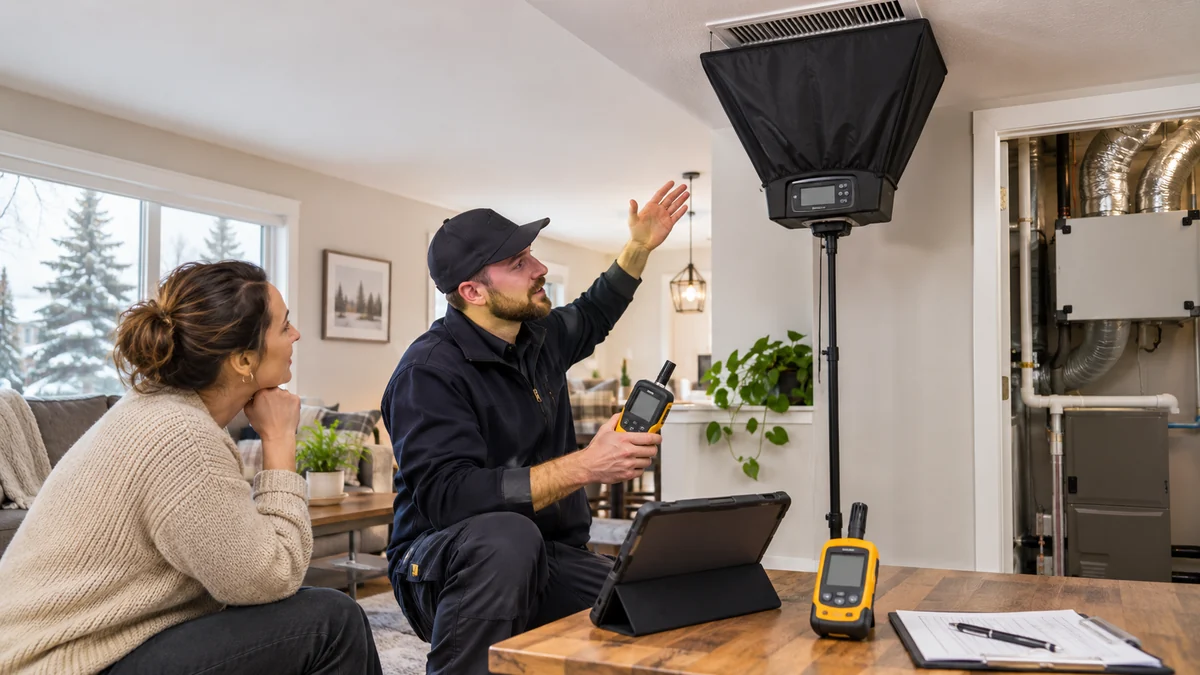
A low-cost monitor can reveal useful patterns, but a single green or red score does not diagnose a building or a health condition. Health Canada notes that no one method or instrument provides an overall measure of indoor air quality.
Start with a question
Define the concern first: moisture, stuffiness, smoke particles, combustion safety, a particular odour or ventilation performance. Inspect the building and equipment, then measure only what helps confirm or reject likely causes.
What an assessment may include
| Tool or observation | Useful for | Does not prove |
|---|---|---|
| Hygrometer | Humidity patterns and condensation risk | The source of moisture by itself |
| CO2 trend | Occupancy and ventilation patterns | Overall air safety or every pollutant |
| PM2.5 monitor | Fine-particle events and filtration comparison | The chemical source of every particle |
| Airflow measurement | Ventilation delivery, exhaust and HRV balance | Health outcomes |
| Visual and moisture inspection | Leaks, condensation and damp materials | What is hidden in every cavity |
Carbon monoxide and radon need dedicated protection
Carbon monoxide cannot be safely managed with a general consumer IAQ monitor. Use certified CO alarms in the required locations and respond immediately to an alarm. Radon also requires a dedicated test conducted for the recommended duration; it cannot be seen or smelled. HVAC inspection does not replace either safeguard.
Why mould air testing is often the wrong first step
Health Canada does not recommend routine air testing for mould in most homes. Results do not predict health effects and may reveal little about why damage occurred. Inspection for water entry, condensation and damp materials is usually more useful. In selected complex cases, a qualified professional may recommend targeted sampling to investigate a hidden source.
Consumer monitors: use trends, not one reading
Sensor quality and calibration vary. Place a monitor away from open windows, direct supply air and cooking sources unless those are the conditions being investigated. Record outdoor conditions, occupancy and equipment operation. A rise during cooking or a drop after ventilation can be useful even when the absolute number is uncertain.
Match the provider to the question
| Question | Useful first provider | Typical next step |
|---|---|---|
| Is the HRV delivering and exhausting the intended airflow? | HVAC or ventilation technician | Measure airflow, inspect controls and balance the system |
| Is humidity, filtration or equipment operation contributing? | HVAC technician | Inspect mechanical systems and record operating conditions |
| Is there radon? | Dedicated radon test or qualified radon professional | Test for the recommended duration and mitigate if required |
| What is an unknown chemical or occupational exposure? | Qualified environmental or industrial-hygiene professional | Define a sampling plan and use an appropriate laboratory |
| What is causing a health symptom? | Qualified health-care provider | Medical evaluation; building measurements do not diagnose illness |
Patterson Mechanical's scope is the building's mechanical side: ventilation airflow and controls, humidity, filtration, furnace or air-handler operation and related equipment. It is not a substitute for laboratory analysis, radon testing, mould remediation, hazardous-material assessment or medical diagnosis. Confirm the requested scope before booking so the visit is matched to the question.
A practical assessment sequence
- Document the room, time, activity and weather associated with the concern.
- Inspect obvious moisture, combustion, exhaust and filtration conditions.
- Review furnace, HRV/ERV, humidifier and fan schedules.
- Select measurements that answer the most likely causes.
- Make one controlled change and verify whether conditions improve.
- Refer health symptoms to a qualified health-care provider.
What to bring to an assessment
Collect monitor screenshots, dates, room locations and a short description of when the concern appears. Include recent renovations, water events, filter changes, new furnishings and changes to exhaust fans or ventilation controls. If the concern is an odour, describe when it occurs rather than trying to mask it before the visit. A timeline helps connect measurements to activities and weather, and it prevents unnecessary testing of contaminants that do not match the complaint.
Patterson Mechanical provides building-focused indoor air quality testing in Manitoba. We assess ventilation, humidity, filtration and mechanical equipment without representing HVAC measurements as a medical diagnosis. Begin with the broader Manitoba indoor-air-quality guide if the problem is not yet defined.
Need to narrow down an indoor-air concern?
Describe the room, timing, activities and equipment involved. We can define the mechanical assessment scope and tell you when a different test or specialist is the better next step.
Request ServiceFrequently Asked Questions
Is there one test for overall indoor air quality?
No. Health Canada states that no single method or instrument provides an overall indication. Measurements should be chosen for a specific concern.
Can a home monitor detect mould?
General IAQ monitors do not identify mould growth. Inspect and correct moisture sources; routine mould air testing is not recommended in most homes.
Does a CO2 reading show whether the air is safe?
CO2 trends can help evaluate occupancy and ventilation, but they do not measure every contaminant and do not replace carbon-monoxide alarms.
Should I test for radon?
Health Canada recommends testing homes for radon with a dedicated radon test. A general HVAC assessment does not measure it automatically.
Can IAQ testing diagnose allergies or illness?
No. It can document selected building conditions. Medical symptoms and diagnoses belong with a qualified health-care provider.