
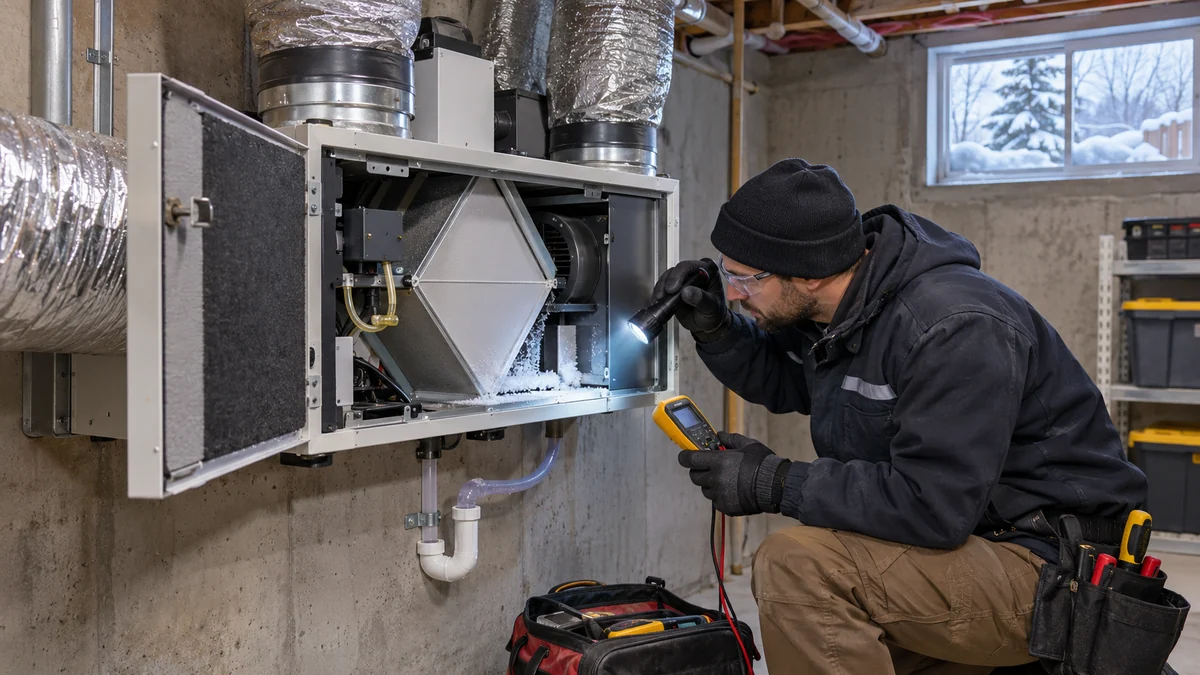
An HRV is designed to handle cold outdoor air, but it must protect its core from frost and drain condensate safely. A normal defrost cycle is different from a cabinet packed with ice or water reaching electrical components.
Safe first checks
Confirm the control setting, disconnect power before opening the cabinet, inspect filters and exterior hoods, and look for a kinked or frozen drain. Do not bypass frost controls, force dampers or apply heat to plastic components.
| Symptom | Possible causes | Response |
|---|---|---|
| Will not run | No power, service switch, controller mode, door interlock, motor or control fault | Confirm safe external controls and power; arrange service if unresolved |
| Stops periodically in cold weather | Normal defrost cycle or intermittent control mode | Observe whether operation resumes before resetting anything |
| Light frost that clears | Normal cold-weather operation and defrost | Monitor and maintain filters and hoods |
| Heavy ice that returns | Restricted airflow, defrost fault, imbalance or control issue | Shut down if unsafe and arrange service |
| Water below cabinet | Blocked drain, loose tubing, poor slope or thawing ice | Protect nearby equipment and inspect drainage |
| Runs continuously | Normal low-speed design, high-humidity call or control setting | Review manual and controller before assuming failure |
| Weak airflow | Dirty filters, blocked hoods, dirty core, fan or duct issue | Complete maintenance, then measure airflow if unresolved |
Why HRVs frost in Manitoba
Warm exhaust air transfers heat to a cold incoming stream. Moisture can condense and freeze on the core during severe cold. The unit should use a designed defrost strategy, such as cycling airflow or recirculating air. Persistent ice suggests that airflow, sensors, dampers or controls are not working as intended.
Why an HRV may leak
Condensate must flow through a pan, tubing and trap to an approved drain. Dirt, biofilm, a missing trap, poor tubing slope, a frozen termination or a cracked fitting can release water. Ice that melts after a defrost failure can create a larger leak. Turn the system off when water threatens electrical parts.
Is continuous operation normal?
Many HRVs are designed to operate continuously at low speed. Bathroom boost switches, a dehumidistat or an automatic control can call for higher speed. If the unit suddenly runs hard all the time, check whether a boost switch is latched, humidity is above the setpoint or a control has been changed.
If the HRV will not run or keeps stopping
- Confirm the wall control is not in standby, off or an intermittent mode that intentionally pauses the fans.
- Check the accessible plug, service switch and electrical panel without opening live equipment.
- Make sure the cabinet door is fully closed; some units use a safety interlock.
- During severe cold, observe whether the pause is followed by normal operation because defrost can temporarily change or stop one airflow.
- If a breaker trips again, a burning smell appears or the unit remains dead, stop resetting it and book service.
What homeowners can maintain
Follow the manual for filters, core, exterior hoods and condensate components. Our HRV maintenance checklist separates safe routine work from balancing and service tasks. Never open live electrical compartments or defeat a safety control.
Record the condition before resetting controls
Take clear photos of frost, water location, control settings and any displayed code before power is interrupted. Record outdoor temperature, whether a bathroom boost was active and how long the symptom had been present. If it is safe, note whether both exterior hoods are clear. This evidence can reveal whether the issue follows severe cold, a control call or a blocked airflow path. Do not repeatedly reset a unit that trips a breaker, smells hot or leaks toward electrical components.
What a technician checks
Diagnosis may include supply and exhaust airflow, filter pressure, fan current, temperature sensors, dampers, defrost sequence, control calls, duct insulation, exterior terminations and condensate drainage. Patterson Mechanical provides HRV repair and ventilation service for Manitoba homes. For system selection, see HRV versus ERV in Manitoba.
Is the HRV freezing, leaking or behaving differently?
Photograph the condition and control settings, then arrange service before repeated resets or water near electrical components causes a larger problem.
Request ServiceFrequently Asked Questions
Is frost inside an HRV normal?
A light amount that clears during the designed defrost cycle can be normal. Persistent heavy ice or blocked airflow is not.
Why is water leaking from my HRV?
A blocked or disconnected condensate drain, poor tubing slope, frozen drain, damaged pan or thawing frost may be involved.
Should my HRV run all the time?
Many systems are designed for continuous low-speed operation. Confirm the manual and controller before switching it off.
Can I thaw an HRV with a heat gun?
No. High heat can damage plastic, wiring and seals. Disconnect the unit and have the frost-control problem diagnosed.
Why does the HRV make my house dry?
Winter ventilation introduces dry outdoor air. Excess airflow, control settings, air leakage and occupancy all affect humidity.