
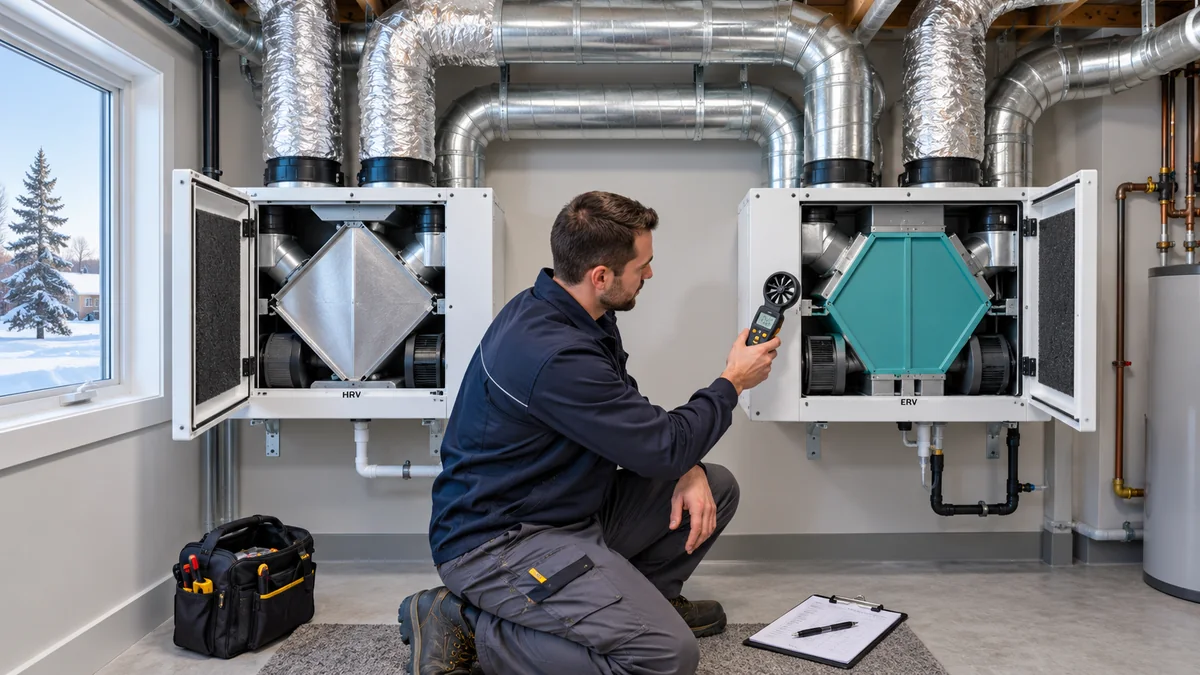
Both systems exhaust stale air and bring in filtered outdoor air while recovering energy. The practical difference is moisture transfer: an HRV mainly transfers heat, while an ERV transfers heat and a portion of the moisture between air streams.
In short
Choose based on measured indoor humidity and house conditions. An HRV can help a humid winter home dry out; an ERV can reduce over-drying in a home that is already too dry. Correct sizing, ducting and balancing are as important as the equipment label.
HRV and ERV differences
| Question | HRV | ERV |
|---|---|---|
| Transfers heat? | Yes | Yes |
| Transfers some moisture? | No | Yes |
| Can help reduce winter humidity? | Often | Less aggressively |
| Can reduce winter over-drying? | Usually no | Often |
When an HRV may fit better
Homes with frequent winter window condensation, higher occupancy or high moisture loads may benefit from the drier outdoor air introduced through an HRV. Controls still need to avoid unnecessary over-ventilation.
When an ERV may fit better
An ERV can be useful where winter humidity is already uncomfortably low or where summer humidity adds cooling load. Health Canada explains that an ERV transfers both heat and moisture, which can reduce over-drying in winter.
Installation details that decide performance
- Correct airflow for the home's size and occupancy
- Balanced supply and exhaust
- Properly sealed and insulated exterior ducts
- Fresh-air distribution to appropriate rooms
- Accessible filters, core and drain
- Controls that occupants understand and will use
Patterson Mechanical provides HRV and ERV installation in Manitoba, including ventilation planning for existing homes and new construction.
Maintenance homeowners should expect
Filters and outdoor grilles need regular attention, and the core, drain and fans should be maintained according to the manufacturer. An imbalanced or obstructed system may not provide the ventilation expected.
For a new build, connect ventilation decisions with the complete HVAC planning process.
Start with the house, not the acronym
The right choice depends on the home's moisture behaviour, air-tightness, occupancy, existing ductwork and how the ventilation system will be distributed. A very dry winter house, a home with persistent window condensation and a high-occupancy home do not present the same design problem. The decision should also account for bathroom exhaust, range-hood operation and combustion appliances.
Ask the installer how outdoor air will reach bedrooms and living areas, where stale air will be collected, how the unit will be balanced and how condensate and frost control will be handled. A unit with good specifications can still perform poorly when ducts are restrictive or airflow is not commissioned.
Use indoor humidity as feedback
Indoor relative humidity is a useful operating signal, but the target is not one fixed number for every day. Outdoor temperature, window performance and household moisture production all matter. If condensation appears on cold surfaces, investigate moisture sources and ventilation operation rather than assuming that switching unit types alone will solve the issue.
HRV vs. ERV comparison for Manitoba homes
| Decision factor | HRV | ERV |
|---|---|---|
| What it transfers | Sensible heat | Sensible heat plus some moisture |
| Winter moisture effect | Generally removes more indoor moisture | Retains some moisture compared with an HRV |
| May suit | Homes with excess winter humidity or persistent condensation | Very dry homes or higher latent loads, after the whole house is assessed |
| Summer operation | Ventilates while recovering some temperature difference | Can also reduce part of the incoming moisture load |
| Cold-weather design | Both need appropriate frost control, condensate handling, duct design and commissioning | |
How HRV and ERV sizing actually works
A 3,000-square-foot house does not automatically require one standard unit size. Design airflow depends on the ventilation standard or code pathway, bedrooms, occupancy, room distribution, exhaust requirements, envelope and duct resistance. The installer should document the required ventilation rate, select a unit that can deliver it at the expected external static pressure, and balance the supply and exhaust flows after installation.
Oversizing can create noise, dryness and short cycling when controls are poorly configured. Undersizing can leave bedrooms or moisture-producing rooms under-ventilated. Ask for the design airflow and final balancing readings rather than choosing only by the maximum CFM printed on the box.
Summer, frost control and operating cost
Either system can operate in summer when outdoor ventilation is needed, but it is not a substitute for air conditioning or dehumidification. In winter, frost-control strategy matters in Manitoba: the unit may recirculate, reduce supply air or run a defrost cycle. Installation cost is affected by capacity, controls, dedicated ductwork versus furnace-duct integration, condensate routing, electrical work and balancing. Compare the complete installed and commissioned system, not just the cabinet price.
Need help with this system?
Patterson Mechanical serves Stonewall, Winnipeg and Manitoba's Interlake region. We will confirm service availability and an appointment window for your property.
Request ServiceVentilation choices in Winnipeg housing
Newer airtight Winnipeg homes often depend on balanced mechanical ventilation, while older homes may require a retrofit strategy that accounts for existing ductwork, exhaust fans, combustion equipment and air leakage. Use our HRV maintenance checklist and review Winnipeg HVAC service availability.
Frequently Asked Questions
What is the main difference between an HRV and an ERV?
Both recover heat. An ERV also transfers some moisture, while an HRV generally removes more indoor moisture during Manitoba winter operation.
What size HRV or ERV does a 3,000-square-foot house need?
Square footage alone is insufficient. Design airflow must consider bedrooms, occupancy, rooms, exhaust requirements, duct resistance and the applicable ventilation standard.
Is it okay to run an HRV in summer?
Yes when ventilation is needed, but controls should account for outdoor heat and humidity. An HRV or ERV does not replace air conditioning or dehumidification.
Should an HRV run all winter?
Many systems use continuous low speed with higher-speed demand, but the correct strategy depends on humidity, occupancy, controls and the design. Follow the commissioned settings.
Can an HRV or ERV connect to furnace ductwork?
Some approved designs integrate with forced-air ductwork. Airflow interaction, controls and balancing must be planned so ventilation works when intended.