
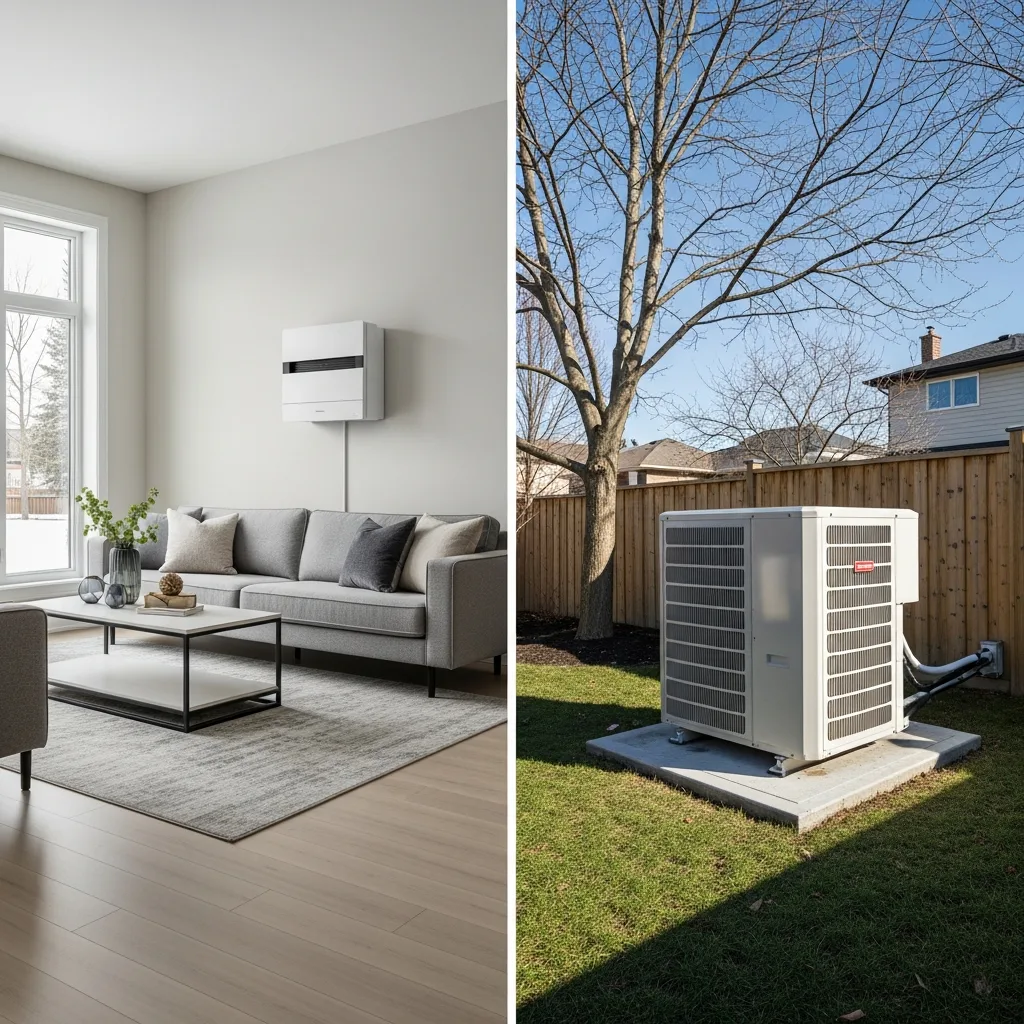
The honest answer to "which system is better" is: it depends entirely on your home. A 1960s bungalow with no ductwork and a new addition over the garage is a completely different situation from a 2015-built two-storey with a full ducted forced-air system already installed. The right choice follows from the home's existing conditions, not from preference.
How Each System Works
Central Air Conditioning
Central AC uses the existing forced-air duct network in your home to distribute conditioned air. An outdoor condenser unit removes heat from refrigerant; an evaporator coil installed in the air handler or furnace cabinet cools the air; the blower distributes it through the ductwork to every room with a supply register. One thermostat controls the entire system.
Ductless Mini-Split
A ductless system uses one or more indoor wall-mounted heads connected to an outdoor condenser via a refrigerant line set run through the wall — no ductwork required. Each indoor head is independently controlled, allowing different temperatures in different rooms (zoning). Systems can have one to five indoor heads served by a single outdoor unit.
Central AC: When It Makes Sense
Your home already has ductwork in good condition. If you have a forced-air furnace with well-maintained ducts, adding central AC is the most cost-effective path to whole-home cooling. You're using infrastructure that already exists.
You want uniform whole-home cooling from a single thermostat. Central AC is a simpler operation for households that want one temperature setting for the whole house. There's nothing to manage in individual rooms.
You're planning a new build with full ductwork. In new construction where duct installation is included in the project budget, a complete central AC system is often the most cost-efficient whole-home solution. See our post on central air conditioning in Manitoba for a full overview, and our central AC cost guide for installed price ranges.
Ductless Mini-Split: When It Makes Sense
Your home has no ductwork. Adding central AC to a home without ducts requires installing a duct system — typically $5,000–$15,000 before the AC equipment itself. A multi-zone ductless system covers the entire home at a lower total cost and without the construction disruption of duct installation.
You need cooling in a room or area that central AC doesn't reach well. Additions, garage conversions, sunrooms, detached workshops, and upper floors that stay hot in summer are common candidates for a single-zone ductless unit. This is the most common scenario we see — adding one ductless unit to a home that otherwise has central AC. See our post on why the upstairs gets so hot in summer for detail on this specific use case.
You want zone control. If two people in the home prefer different temperatures, or if certain rooms are rarely occupied, ductless zoning lets you cool only what needs cooling. This can reduce energy use compared to running central AC for a whole house when only part of it is in use.
You want heating and cooling from one system. Ductless mini-splits that function as heat pumps provide both — efficient electric heating down to very low temperatures and cooling in summer. For homes currently on electric baseboard heating, replacing with a ductless heat pump dramatically reduces heating costs and adds cooling. For the cost of a ductless system, see our ductless mini-split cost guide.
Side-by-Side Comparison
Can You Have Both?
Yes — and it's more common than you might think. Homes with central AC often add a ductless unit specifically for an upper floor that the central system struggles to cool, a new addition, or a detached garage. The ductless unit handles the areas the central system can't reach, and the central system continues to handle the main floor. For the right sizing on your central system, our post on choosing the right size AC for your Manitoba home explains the load calculation process.
Rebates: Ductless Often Has the Edge
Because ductless mini-splits function as heat pumps when heating-capable models are chosen, they attract more provincial and federal rebate programs than cooling-only central AC units. This can meaningfully affect the net cost comparison. Our post on HVAC rebates available in Manitoba covers current eligibility in detail.
For ductless mini-split installation in Manitoba or central air conditioning in Manitoba, we quote both options when the situation warrants a comparison — so you can make an informed decision with real numbers in front of you.
If efficiency ratings are part of your decision, our guide to what SEER rating is right for Manitoba explains the payback math for different efficiency tiers. If your existing system seems to run more than it should, our post on why your AC runs constantly in Manitoba covers whether that's a sizing or mechanical issue.
Not Sure Which System Is Right for Your Home?
We assess your home and quote both options where applicable. Serving Stonewall, Winnipeg, and the Interlake.
Book a Free AssessmentFrequently Asked Questions
Is ductless or central AC better for a Manitoba home?
Neither is universally better — it depends on your home. Central AC is the better choice for homes with existing ductwork in good condition where you want whole-home cooling. Ductless is better for homes without ductwork, for adding cooling to specific rooms, or for situations where independent zone control is valuable. Many Manitoba homes have both.
Can I add a ductless unit to a house that already has central air conditioning?
Yes, and this is a common approach. Ductless units are frequently added to specific areas — upper floors, additions, garages — where the central AC doesn't reach well or lacks capacity. The two systems operate completely independently and don't interfere with each other.
How much more does a whole-home ductless system cost compared to central AC?
For a home with existing ductwork in good condition, central AC is typically less expensive — installed costs run $3,500–$7,000 versus $6,500–$14,000+ for three or four ductless zones. For a home without ductwork, the comparison reverses: adding ducts for central AC can cost $5,000–$15,000 on top of the equipment, making multi-zone ductless the more economical total solution.
Which system is more energy-efficient in Manitoba?
Modern ductless mini-splits with inverter-driven compressors are generally more energy-efficient than central AC because they modulate output rather than cycling fully on and off, and they avoid duct losses. However, the efficiency advantage is most relevant in Manitoba where both heating and cooling loads are significant — a heat pump mini-split that handles both provides much better annual efficiency than a cooling-only comparison would suggest.