
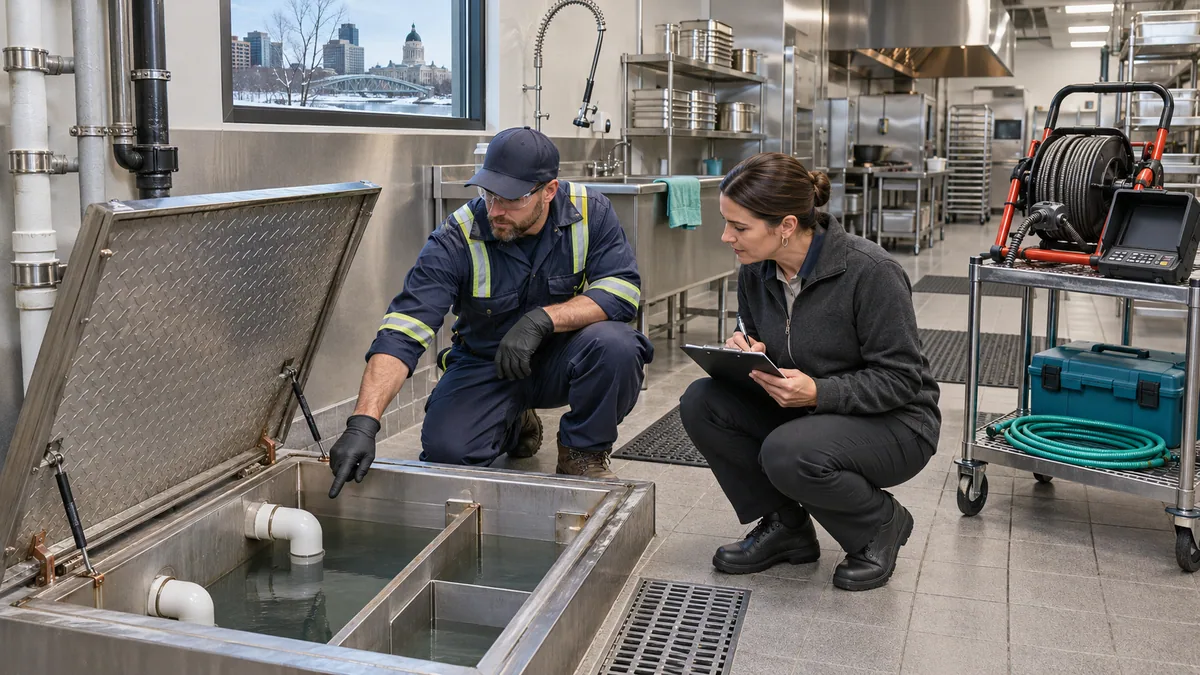
Commercial drain failures are rarely just plumbing inconveniences. They can close washrooms, interrupt food service, contaminate storage, damage tenant spaces and create public-health concerns. A useful plan connects daily practices, grease-interceptor maintenance, scheduled cleaning and emergency authority.
Program essentials
Map fixtures and cleanouts, identify grease and sediment controls, keep required logs, schedule maintenance before historical failure points, train staff on what cannot enter drains, and define who can stop operations and call for emergency service.
Start with a drain-system inventory
Record kitchens, prep sinks, dishwashers, mop sinks, floor drains, washrooms, laundry, mechanical-room drains, roof or area drains where applicable, interceptors, cleanouts and the private sewer route. Note which tenant or department uses each area and which shutdown would affect sanitation or production.
Patterson Mechanical provides commercial drain and sewer cleaning in Manitoba. For broader fixture, water-heater and building-plumbing work, see our commercial plumbing services.
Winnipeg grease-interceptor requirements
Winnipeg's Sewer By-law requires grease traps or interceptors for commercial, institutional and food-preparation operations. The City states that the device must be installed by a licensed plumber, sized for the wastewater flow, kept accessible, maintained so it functions, and supported by maintenance records for the previous 12 months.
Requirements elsewhere in Manitoba may differ. Confirm the authority having jurisdiction, applicable plumbing rules and wastewater agreement for each facility rather than assuming the Winnipeg rule applies province-wide.
Control grease before it reaches the drain
- Scrape plates and cookware into appropriate waste containers before washing.
- Use sink strainers and empty them into waste, not another drain.
- Keep fryer oil and bulk grease in approved collection containers.
- Do not rely on hot water or chemicals to move grease downstream.
- Train every shift and include temporary staff.
- Keep interceptor covers accessible and the area free of stored goods.
An interceptor captures material only until its effective volume is reduced. Waiting for odour, slow flow or backup means the maintenance trigger has already been missed.
Set a condition-based cleaning schedule
| Record | Why it matters |
|---|---|
| Date, time and contractor | Establishes accountability |
| Material depth or fullness before cleaning | Shows whether the interval is appropriate |
| Volume removed and disposal record | Supports waste and service documentation |
| Condition of covers, baffles and seals | Identifies repair needs |
| Downstream flow or cleaning findings | Separates interceptor service from line buildup |
| Operational changes | Explains changes in loading |
High-volume operations, menu changes, seasonal peaks and tenant turnover can change the needed interval. Review the log rather than copying a generic monthly or quarterly schedule.
Plan main-line and branch maintenance
Track slow fixtures and repeated locations by asset number. A kitchen branch with recurring grease, a laundry line with lint, a garage interceptor and a building sewer with roots need different equipment and safeguards. Camera inspection after cleaning can document defects or remaining buildup where access and pipe condition allow.
Coordinate work with food protection, tenant notices, security, alarms, after-hours access, wastewater containment and reopening checks. Manitoba's public-health guidance says a food establishment should discontinue operation if a sewage overflow prevents sanitary conditions. The emergency plan should identify who makes that decision.
What staff can do—and what belongs to contractors
Staff can report symptoms, stop using affected fixtures, protect food and public areas, follow approved spill procedures and provide access records. They should not mix drain chemicals, open hazardous interceptors, bypass plumbing, work in confined spaces or continue operating without sanitary handwashing and wastewater control.
For the building-wide schedule, use our commercial plumbing maintenance checklist. For winter risk, see preventing frozen commercial plumbing.
Assign responsibility before a backup
| Role | Defined responsibility |
|---|---|
| Shift supervisor | Stops affected fixtures, protects food/public areas and starts the call tree |
| Property or facility manager | Authorizes after-hours access, shutdown and diagnostic spending |
| Grease-interceptor service provider | Removes captured material and documents interceptor condition |
| Plumbing/drain contractor | Clears and inspects branches, cleanouts and the private sewer |
| Restoration or sanitation team | Contains contamination, cleans and documents affected materials |
| Operator/public-health contact | Determines whether sanitary operation can continue or reopen |
Write the names, phone numbers and authorization limits into the plan. A contractor restoring flow does not by itself declare a food area sanitary or approve reopening.
Build the emergency call package
- Property address, access contact and after-hours number
- Fixture/drain ID and area served
- Whether sewage is actively overflowing
- Food, electrical or public-access exposure
- Known cleanouts and interceptor locations
- Last service date and prior findings
- Authority to shut down, clean and approve additional work
This information shortens diagnosis and helps the service team bring appropriate equipment without turning the first hour into a building search.
Need a commercial drain maintenance plan?
Bring the fixture map, interceptor records and recurring trouble points. We can build a documented cleaning and response scope around the facility's actual risk.
Request Drain or Sewer ServiceFrequently Asked Questions
How often should a commercial grease interceptor be cleaned?
Use the manufacturer, by-law requirements, measured accumulation and operating load. Record fullness at each service and shorten the interval before performance is affected.
Does Winnipeg require grease-trap records?
Yes. The City says maintenance activities must be recorded and the previous 12 months of records made available for inspection.
Can hot water or enzymes replace grease-interceptor cleaning?
No product should be treated as a substitute for required capture, inspection and removal. Confirm any additive with the authority and equipment guidance before use.
When should a food business stop operating during a backup?
Manitoba public-health guidance calls for discontinuing operation when sanitary conditions cannot be maintained or sewage continuously overflows.
Should commercial sewer lines be camera-inspected every time?
Not automatically. Cameras are useful after recurring, unexplained or structural concerns, provided the line is clean and accessible enough for meaningful footage.