
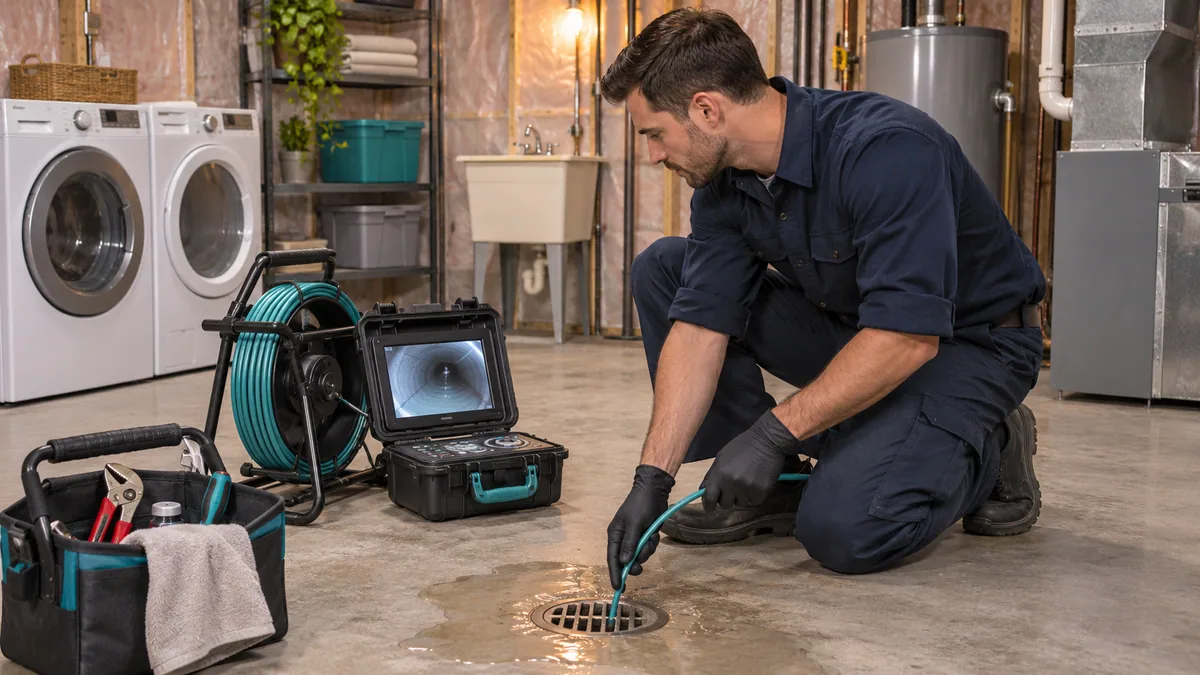
A basement floor drain that rises when a toilet flushes or washer drains is warning you that wastewater cannot move normally downstream. Stop using water until you know whether the problem is limited to one branch or affects the building's main drain or sewer.
First actions
Stop fixtures that trigger the rise, keep people away from contaminated water, check whether multiple low fixtures are affected and arrange drain or sewer service. Do not keep testing with more water; every test adds volume behind the restriction.
Why water appears at the floor drain
The floor drain is usually one of the lowest open fixtures. When flow is blocked downstream, wastewater may emerge there before it reaches higher fixtures. The drain itself may be open and functioning as the visible relief point; cleaning only its grate will not correct a restriction farther away.
| Trigger | Likely area to investigate | Why |
|---|---|---|
| Only water poured into the floor drain is slow | Floor-drain trap or short branch | The symptom may be local |
| Washer discharge raises the floor drain | Laundry branch or building drain | High discharge reveals reduced capacity |
| Toilets and several drains gurgle | Building drain or private sewer | Multiple fixtures share the restriction |
| Rise occurs during heavy rain without indoor use | Backflow protection and sewer conditions | External sewer level may be contributing |
These patterns narrow the investigation but do not replace cleaning and inspection. Our drain-versus-main-sewer guide covers additional warning signs.
What the water source and timing can reveal
| What appears | Possible source | First check |
|---|---|---|
| Dirty water rises when indoor fixtures run | Branch, building drain or private sewer restriction | Stop indoor water use |
| Water rises with no indoor use during heavy rain | Sewer surcharge, backflow or groundwater connection | Report flooding and assess protection |
| Clear water near HVAC equipment on dry days | Condensate drain, humidifier or relief discharge | Turn off the affected equipment if safe and trace the discharge |
| Clear water enters at walls or floor cracks | Foundation drainage or overland water | Document the entry point and exterior conditions |
Water can mix by the time it reaches the drain, so treat an uncertain source cautiously. A plumber, drainage contractor, HVAC technician or restoration firm may have different roles depending on where the water originates.
Safe troubleshooting boundaries
You can note which fixture triggers the problem, whether the drain cover is visibly obstructed and whether an accessible backwater-valve cover area is flooded. Do not remove a valve cover during active backflow, open electrical equipment, mix drain chemicals, or insert a consumer snake into an unknown drain while fixtures are backing up.
If the water may contain sewage, treat the area as contaminated. Keep children and pets out. If water is near electrical equipment, do not enter. Contact your insurer if building materials or belongings are damaged.
What professional diagnosis should determine
Patterson Mechanical provides main-drain and sewer cleaning across Manitoba's service area. The initial goal is to select a safe access point, restore flow and record where the obstruction was encountered. Once the line is clear enough, a camera can check for roots, buildup, an offset joint, break, standing water or deformation.
Ask for the access point, approximate distance, material removed and whether the line received a post-cleaning inspection. If the problem returns soon, the recurring-clog guide explains why repeating the same method may not address the cause.
Could it be a backwater valve problem?
A backwater valve is designed to close against reverse flow from an overloaded sewer. Debris, lack of maintenance, an unsuitable installation or a different blockage can affect how the system behaves. A closed valve also means the protected fixtures cannot discharge normally until external conditions subside. Do not force or disable the valve; have its placement and condition assessed.
Winnipeg's rules and housing history are discussed in our backwater-valve guide. Outside Winnipeg, permit and installation requirements should be confirmed with the local authority.
After the immediate blockage
Clean and dry the affected area using public-health guidance. Preserve service records and create a prevention plan tied to the cause: grease control, root cleaning, repair, valve maintenance or changes to what enters the drain. A floor drain that stopped overflowing is not evidence that the underlying restriction is gone.
Floor drain rising when fixtures run?
Stop water use and tell us which fixture triggers the rise. We can identify a practical access point, restore flow and document the cause.
Request Drain or Sewer ServiceFrequently Asked Questions
Why does my floor drain back up when the washer runs?
Washer discharge is fast and can reveal reduced capacity in the laundry branch, building drain or private sewer. Stop the washer and arrange diagnosis.
Can I plug the floor drain to stop the water?
Do not improvise a plug during an active backup. Pressure may redirect wastewater to another fixture, and a floor drain can have required safety and drainage functions.
Does a floor-drain backup always mean the City sewer is full?
No. Private branch and sewer restrictions are common. Rain timing and neighbourhood symptoms are clues, but location evidence is needed.
Will drain cleaner fix a basement floor-drain backup?
Chemical cleaners are not appropriate for many main-line obstructions and can add hazards for occupants and technicians. Stop water use and get the line assessed.
Should the sewer be camera-inspected after cleaning?
A camera is especially useful after recurring, root-related or unexplained backups because cleaning restores flow but may not reveal or correct the structural cause.