
Dust, pollen, pet material and mould-related dampness can occur together, but they do not have one universal HVAC solution. Start by identifying whether the main problem is an airborne particle, an indoor source, outdoor infiltration, high humidity or active water damage.
What helps
Filtration can reduce particles moving through the air. Ventilation dilutes indoor pollutants when outdoor air is clean. Humidity control reduces conditions that support dampness. Moisture repair is essential when mould is present.
Match the intervention to the problem
| Concern | Useful mechanical approach | What it cannot replace |
|---|---|---|
| Dust and pollen | Compatible central filtration, sealed rack and portable HEPA where useful | Cleaning and reducing the source |
| Pet particles | Filtration plus adequate fan circulation | Grooming, cleaning and room management |
| High humidity | Exhaust, HRV/ERV adjustment or dehumidification | Repairing leaks and drainage problems |
| Visible mould | Moisture assessment and ventilation support | Physical cleanup and correcting wet materials |
| Odours or VOCs | Source control and clean-air ventilation | Assuming a particle filter captures every gas |
Filtration for particles
A properly fitted central filter can capture particles that reach the return-air system. Higher efficiency may help smaller particles, but airflow and filter area must remain suitable for the equipment. A portable HEPA unit can provide added room-level cleaning when selected by CADR.
Use our furnace-filter MERV guide to evaluate central media without assuming the highest number fits every system.
Reduce the source before upgrading equipment
- Use a damp cloth or mop for settled dust rather than repeatedly putting it back into the air.
- Use a HEPA-equipped portable vacuum or a central vacuum that exhausts outdoors.
- Wash bedding regularly and use mattress and pillow protectors when dust-mite exposure is a concern.
- Keep the dryer vented outdoors, clean its lint screen and confirm the exterior termination is clear.
- Control renovation dust at the work area instead of expecting the furnace filter to collect it throughout the house.
- Inspect return-air joints and the filter rack for bypass paths that can draw unfiltered dust into the system.
Ventilation and outdoor allergens
Ventilation is essential, but outdoor conditions matter. During high pollen or smoke periods, uncontrolled window ventilation may introduce more particles. An HRV or ERV needs clean filters and an appropriate intake location. Some systems can use upgraded intake filtration, but the added resistance must be considered.
Mould begins with moisture
Health Canada recommends correcting excessive moisture and cleaning visible mould rather than relying on routine air testing. An air purifier may reduce some airborne material, but it cannot dry a wet wall, repair a roof leak or remove contaminated building material. Persistent or extensive damage may require a separate qualified remediation professional.
HVAC service can address ventilation, humidity and filtration conditions that contribute to dampness, but it does not replace removal of mould-damaged material or repair of the water source. If mould returns after cleaning, appears across a large area, follows flooding or involves hidden wall and ceiling cavities, obtain appropriate remediation and building-envelope advice.
Humidity: avoid both extremes
Health Canada commonly recommends 30% to 50% relative humidity, subject to the building envelope. Too much winter humidity can condense on windows and walls. Very low humidity can increase discomfort. Measure before adding or removing moisture and look for room-to-room differences.
Seal bypasses before buying more filtration
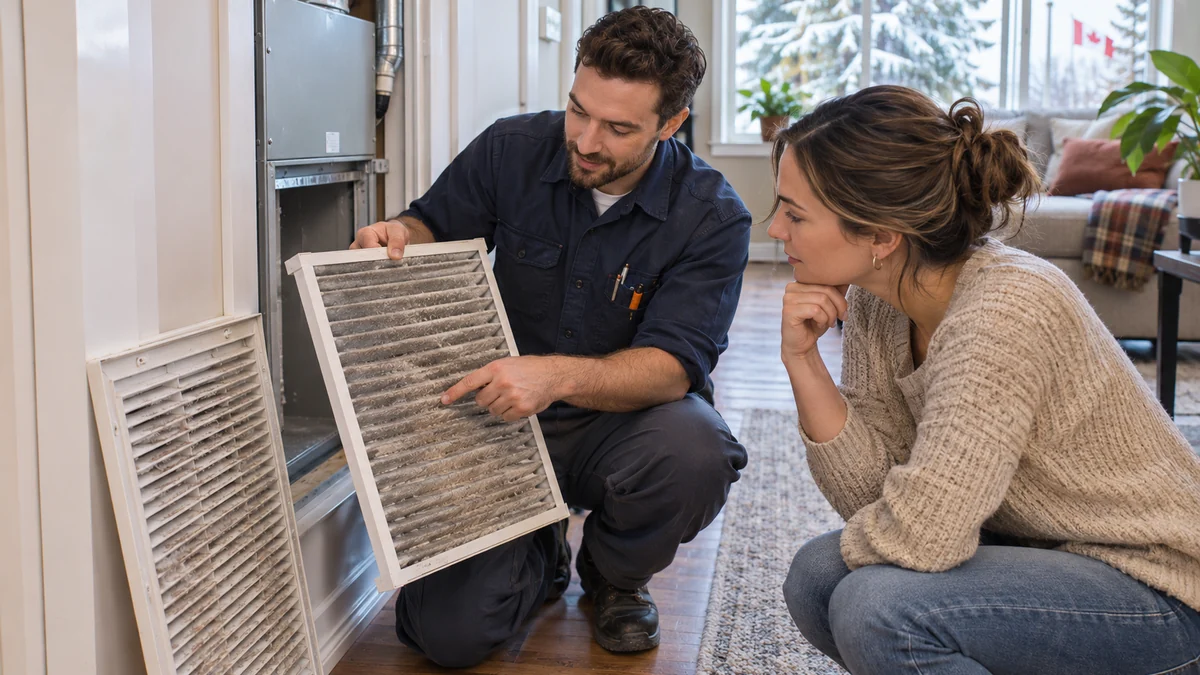
Dust streaks around a filter rack, loose return-air joints or a filter that does not fill the slot can allow air to bypass the media. That can leave the home dusty even after a higher-rated filter is installed. Check that the filter faces the correct direction, fits the cabinet and seals around its frame. A technician can also look for return-side leakage, confirm blower airflow and determine whether a larger media cabinet would improve filtration without creating excessive restriction.
Scope and next steps
Patterson Mechanical provides air filtration for allergies and mould-related moisture concerns. Our role is to assess HVAC filtration, humidity and ventilation. We do not identify a person's allergens, diagnose medical conditions or perform extensive mould remediation. Health symptoms belong with a qualified health-care provider, while water damage and substantial mould growth may require remediation or building-envelope specialists. Start with the complete indoor-air-quality framework when several concerns overlap.
Does dust return soon after cleaning?
We can inspect filter fit, return-air bypass, airflow, ventilation and humidity, while keeping mould remediation and medical diagnosis with the appropriate specialists.
Request ServiceFrequently Asked Questions
Can a better furnace filter help with allergies?
It can reduce selected airborne particles when the filter fits and the system maintains airflow. It does not remove every trigger or replace medical advice.
Will an air purifier remove mould?
It may capture some airborne particles, but it does not remove mould growth or correct the moisture source that allowed it to develop.
Should I test the air for mould?
Health Canada does not recommend routine mould air testing in most homes. Inspection for dampness and correcting moisture are usually more useful.
Can high humidity make dust problems worse?
High humidity can support dust mites and condensation-related dampness. Measure humidity and keep it within the building's safe range.
Do HRVs remove pollen?
HRVs exchange air and have protective filters, but standard HRV filters may not capture very small particles. Compatible upgraded filtration may be considered.