
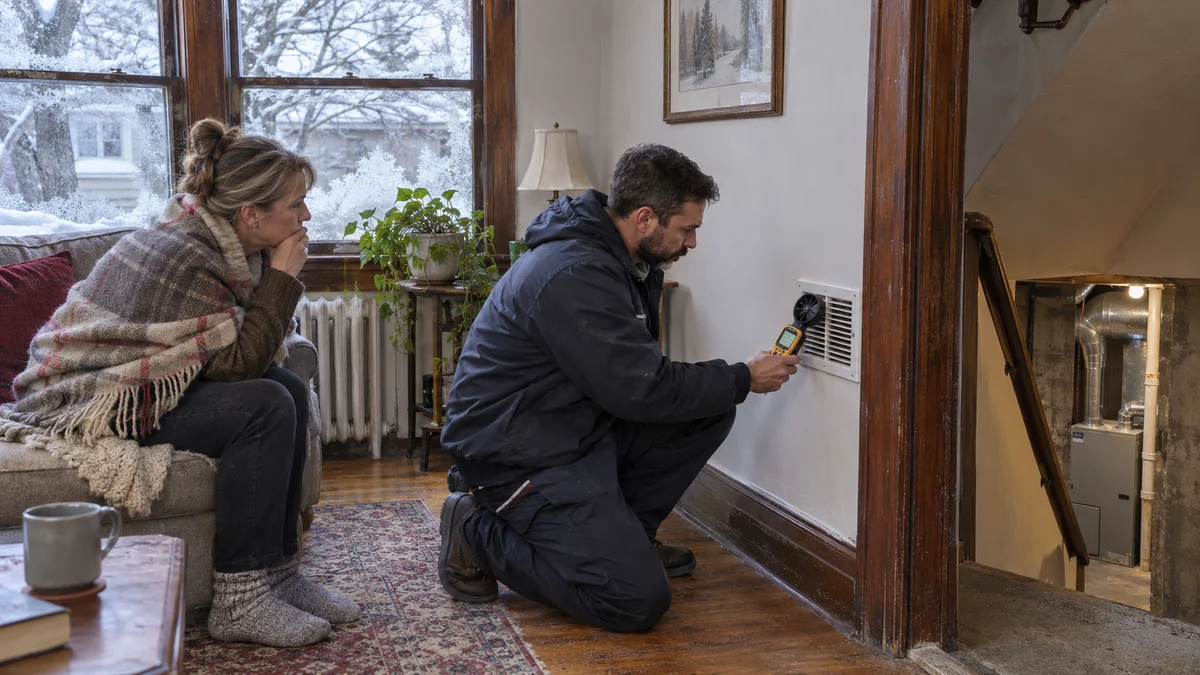
A furnace may run for long stretches during Manitoba cold snaps, especially in an older or high-heat-loss home. Continuous operation becomes a problem when the indoor temperature keeps falling, the furnace never reaches setpoint, heat is weak at the registers, or only part of the house remains comfortable.
Separate four possible problems
- Heat production: the furnace is not producing its expected output.
- Airflow: heat cannot move through the equipment correctly.
- Distribution: ducts do not deliver enough air to the affected rooms.
- Heat loss: the building is losing heat faster than the system can replace it.
Check whether the room temperature is stable, rising or falling
Record thermostat setpoint and actual temperature at the same time every 30 to 60 minutes. A furnace that runs steadily while holding the home near setpoint during extreme cold may be operating normally. A widening gap means the system and building need attention.
Do not keep raising the thermostat; it does not make a single-stage furnace heat faster. Note outdoor conditions, wind, recent snowfall, which rooms are cold and whether supply air feels strong and warm.
What the room pattern suggests
| Pattern | Likely direction | First evidence |
|---|---|---|
| Every room is cold; supply air is weak | Filter, blower, return or system-wide duct restriction | Filter condition and all return grilles |
| Every room is cold; airflow is strong but only mildly warm | Heat production, burner staging or equipment fault | Cycle pattern and fault code |
| Only distant or upper rooms are cold | Duct leakage, balancing, return or envelope issue | Room-by-room temperatures and register airflow |
| Home loses heat mainly in wind | Air leakage and envelope exposure | Draft locations and affected elevations |
| Problem began after renovation | Changed load, closed returns or altered duct path | Renovation scope and before/after comfort |
Safe airflow checks
Check the filter, open normal supply registers and make sure furniture, rugs and storage do not block returns. A dense or dirty filter can reduce airflow even when the blower sounds busy. Do not close registers in unused rooms to force heat elsewhere; that can increase system pressure and worsen delivery.
If one part of the home remains cold, use our uneven-heating and ductwork guide. Patterson Mechanical provides heating-system and airflow assessment where distribution—not furnace output—is the constraint.
Furnace output and staging
A burner, gas-pressure, control or staging problem can reduce available heat without stopping the furnace completely. On multi-stage or modulating equipment, the controls should increase output as conditions require. Diagnosis may include temperature rise, combustion, gas pressure, blower airflow and control calls. These are not homeowner adjustments.
Patterson Mechanical provides furnace repair and performance diagnosis in Manitoba. Tell us whether the furnace runs continuously or cycles, whether air is warm at the closest register, and whether the temperature falls in every room or only specific areas.
Heat loss can exceed a working furnace's delivery
Air leakage, missing insulation, leaky ducts through cold spaces, large window losses and open fireplace dampers can increase demand. That does not prove the furnace is undersized. A larger furnace connected to inadequate ducts can create noise, limit trips and uneven temperatures without correcting the building problem.
For Winnipeg character homes and renovated additions, compare the room pattern with the duct layout and building changes. Our Winnipeg HVAC service page describes local coverage, while home heat-loss warning signs helps separate envelope clues from equipment failure.
When the situation is urgent
Call promptly when indoor temperature is falling quickly, vulnerable occupants are affected, plumbing could freeze, the furnace produces a fault code, or there is water near electrical equipment. Leave the building for a gas odour or CO alarm and call emergency or utility help from a safe location.
Is the furnace running without keeping up?
Record the temperature trend and affected rooms. We can separate furnace output, airflow, duct distribution and heat-loss problems before recommending work.
Request Furnace ServiceFrequently Asked Questions
Is it normal for a furnace to run continuously in extreme cold?
It can run for long periods near the home's design conditions. If it holds temperature and operates safely, long runtime alone is not proof of failure.
Why is the furnace running but the thermostat temperature is falling?
The furnace may have reduced output, poor airflow, duct delivery problems or the home may be losing more heat than the system can replace.
Will closing vents in unused rooms send more heat upstairs?
It can increase duct pressure and reduce total airflow. Balancing changes should consider the whole supply and return system rather than closing many registers.
Does a constantly running furnace need replacement?
Not necessarily. Diagnose equipment output, airflow, duct delivery and building heat loss before making a replacement decision.
What information should I collect before a service call?
Record thermostat setpoint and actual temperature, outdoor conditions, cycle pattern, affected rooms, filter condition, fault codes and whether supply air is warm and strong.