
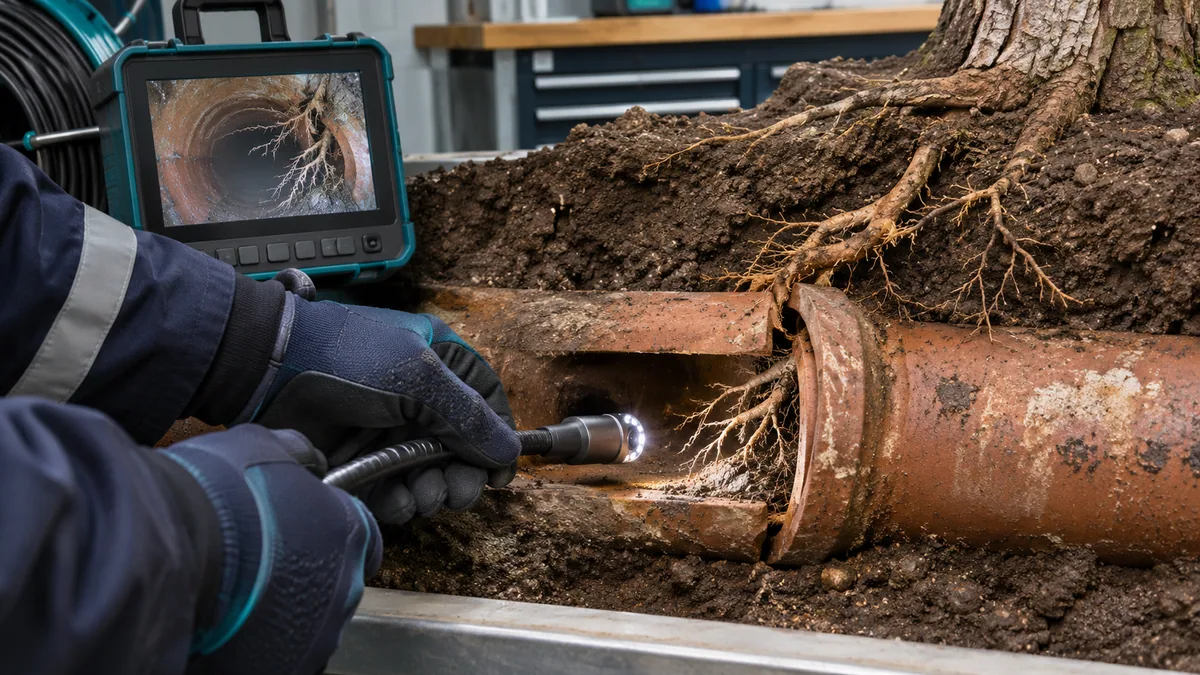
Tree roots do not need to crush a sound sewer pipe to cause a serious blockage. In older laterals, fine roots can enter through an open joint, crack or separation, then grow into a dense mass that catches paper and solids.
In short
Remove roots to restore flow, inspect the cleaned pipe to find the entry point, and base the next decision on pipe condition and recurrence. Repeated cutting is a maintenance strategy—not proof that the defect has been repaired.
Why Winnipeg laterals develop root intrusion
The City of Winnipeg explains that roots are attracted to soil, air and water available through an existing opening. Older sewer pipes may crack or separate because of age, ground movement and heaving. Mature boulevard and yard trees can make the symptoms more frequent, but removing a healthy tree does not automatically repair the opening in the pipe.
Property owners are responsible for maintaining the private sewer from the building to the City main, including the portion under the street. That ownership point matters when planning inspection and repair; read our guide to Winnipeg private-sewer responsibility.
Root removal, camera inspection and repair do different jobs
| Step | What it answers | What it cannot prove |
|---|---|---|
| Mechanical root cutting | Can flow be restored through the obstruction? | That the joint or crack is sealed |
| Post-cleaning camera | Where roots enter and what condition is visible? | Future life without a usable recording and interpretation |
| Locating/tracing | Where is the camera head or defect from the access point? | Exact repair scope without site and permit review |
| Repair or replacement | Can the defective section be corrected? | That every blockage elsewhere disappears |
Patterson Mechanical provides sewer cleaning and camera inspection for root-related blockages in Winnipeg and the surrounding service area.
When scheduled root maintenance can be reasonable
Planned cleaning may be a practical risk-control measure when the line remains serviceable, the root location is known, intervals are predictable and a backup would be avoided by acting early. Record each service date, access point, tool used, distance and findings. A vague note that the line was “snaked” is not enough to see whether the interval is shrinking.
The City advises that properties more than 20 years old, with a history of roots or large trees around the sewer, may require regular cleaning. That is a general warning—not a universal schedule. The right interval comes from the specific pipe history and inspection evidence.
Signs that repair deserves a closer look
- Backups recur sooner after each cleaning.
- The cutter repeatedly stops at the same distance.
- Camera footage shows a displaced joint, crack, missing section or deformation.
- The line cannot be cleaned or inspected through the suspected defect.
- There is soil entry, standing water or another condition that traps solids.
- The cost and disruption of repeated emergency calls is becoming unacceptable.
Ask for a recording with distance markers and a plain-language condition summary. A still image of roots before cleaning shows the symptom; post-cleaning footage is usually more useful for evaluating the pipe wall and joint.
What the post-cleaning camera should document
- The access point and direction of travel
- The distance to every root-entry location
- Whether the cutter opened the full visible diameter
- The condition of the joint or crack beneath the removed roots
- Standing water, offsets or debris that could catch solids
- The farthest point reached and any uninspected section
Keep the full video and a few labelled stills. This creates a baseline for the next maintenance visit and lets repair bidders price the same observed condition.
Questions to ask before approving repair
Confirm where the defect is, how it was located, which portion of pipe is affected, what access and permits are required, and how the proposed method deals with the opening. Compare localized repair, a longer replacement and any lining option only after confirming that the pipe geometry and condition suit the method. Our repair-versus-replacement framework provides the full checklist.
Do not apply unapproved chemical root killers or attempt to clear a sewer with consumer tools when wastewater is already backing up. Stop water use and arrange qualified service. For local coverage, visit our Winnipeg service page.
Roots in the line again?
Bring any prior cleaning dates and camera footage. We can restore flow, document the entry point and help separate scheduled maintenance from a repair decision.
Request Drain or Sewer ServiceFrequently Asked Questions
Do tree roots always mean the sewer must be replaced?
No. The decision depends on the opening, pipe material and condition, recurrence, access and consequences. Some lines are managed with planned cleaning; others have a repairable defect.
Should a sewer camera be used before or after root cutting?
Pre-cleaning footage can confirm the obstruction, but post-cleaning footage is often more useful for seeing the joint, crack and pipe wall beneath the roots.
Will removing the tree solve root intrusion?
Not by itself. The pipe opening still exists, and roots from other plants may use it. Tree work should be assessed separately from sewer repair.
How often should roots be cut from a Winnipeg sewer?
There is no safe universal interval. Use the property's backup history, prior service dates and camera findings to establish a preventive schedule.
Who pays for roots under the street?
Winnipeg states that the owner is generally responsible for the private lateral all the way to the City main, including the portion under the street, subject to the City's current program rules and findings.