
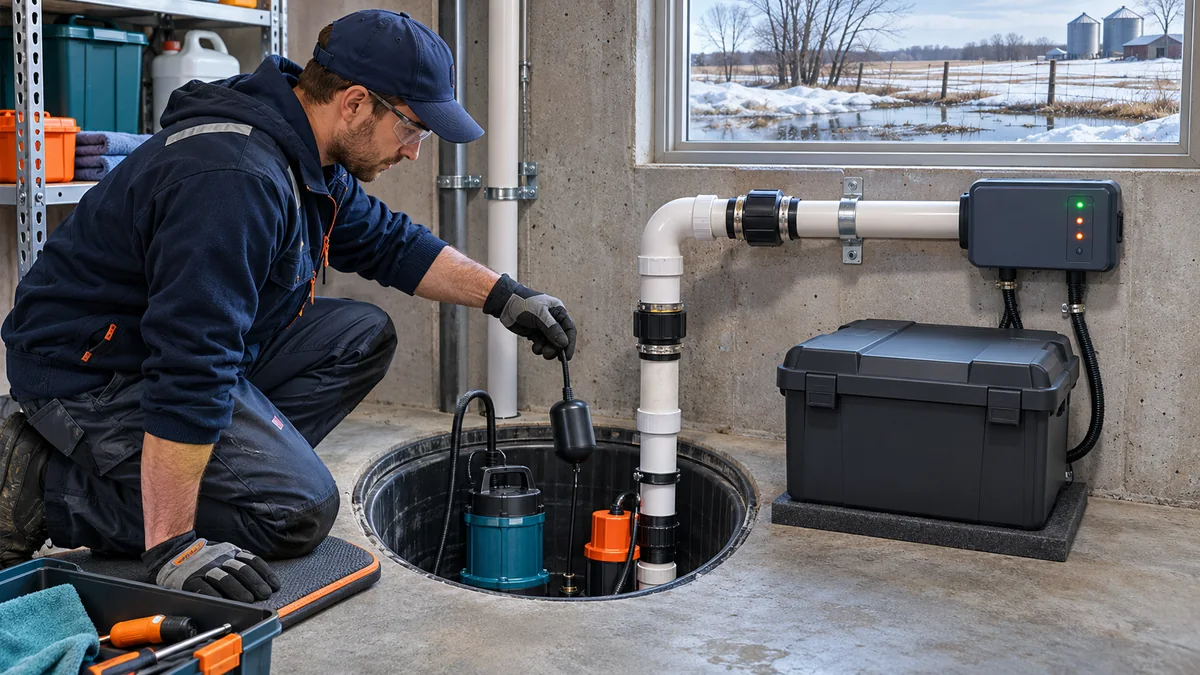
Heavy rain and snowmelt can arrive with power interruptions—the same time a sump system is most important. Manitoba's Flood Resilient Guide specifically lists a backup battery as a flood-mitigation measure because storms can interrupt electrical service.
In short
A battery backup is worth considering when the basement contains valuable finishes, the pump runs regularly, outages occur, the home is unattended or a sewer/water event would be costly. It must be sized, installed and tested as a system.
What a battery-backup sump pump does
A separate DC pump, float and controller activate when water rises above the primary pump's normal level or utility power fails. It is not simply a battery attached to the existing AC pump.
Runtime is not one fixed number
Runtime depends on battery capacity and condition, pump draw, discharge head, cycle frequency and incoming water. Marketing estimates based on occasional cycles may not reflect continuous inflow during a major event.
Questions to answer before selecting a system
- How often does the primary pump run during peak thaw?
- How high and how far must water be discharged?
- Does the backup share a discharge or have its own?
- Can the discharge freeze or become blocked?
- How will alarms be heard when nobody is home?
- Where can the battery be kept dry, accessible and ventilated as required?
Maintenance and testing
- Follow the manufacturer test procedure.
- Confirm both floats move freely.
- Inspect check valves and visible discharge piping.
- Keep the battery and electrical connections dry and protected.
- Replace the battery based on testing and manufacturer guidance, not appearance alone.
- Test before spring thaw and after any major event.
Patterson Mechanical provides sump-pump installation and discharge-line service, including assessment of primary and backup arrangements.
A backup pump cannot overcome every failure
A frozen, blocked or poorly routed discharge can stop both pumps. An undersized basin, failed check valve or inflow beyond system capacity also needs correction. Review why sump pumps fail during spring flooding for the broader system risks.
Primary pump, backup pump and alarm serve different jobs
The primary pump handles normal inflow. A battery-backup pump is a second pumping path for selected failures, while a high-water alarm provides warning. Combining all three creates more resilience than relying on one feature, but each component still needs testing. An alarm without a response plan only tells you that water is rising.
Place alarm notifications where someone can act on them, especially during travel. Keep the installer, pump model, battery type and replacement date in an accessible record. If the home experiences rapid inflow, ask how long the selected backup is expected to operate under that load and what happens when battery capacity is exhausted.
Consider the whole drainage path
A working pump cannot help if its discharge line is frozen, blocked, disconnected or sending water back toward the foundation. Inspect the accessible discharge route and exterior outlet as part of seasonal maintenance. Changes to grading or discharge location must also respect local requirements and neighbouring properties.
Choose the battery the backup system specifies
| Battery type | Advantages | Maintenance considerations |
|---|---|---|
| Flooded deep-cycle | Common backup-pump option with high reserve capacity | May require electrolyte checks, ventilation and terminal cleaning |
| AGM deep-cycle | Sealed, lower-maintenance design | Higher purchase cost; charger must be compatible |
| Automotive starting battery | Designed for short starting bursts | Usually not the correct substitute for repeated deep discharge |
Use the battery type, size and reserve capacity specified by the pump manufacturer. Zoeller, for example, recommends a Group 27 deep-cycle battery with at least 175 minutes of reserve capacity for one Aquanot system and advises replacement every three years. That recommendation belongs to the cited system; follow the manual for the equipment actually installed.
Runtime depends on pumping conditions
A manufacturer test can illustrate why one runtime claim is not universal. Zoeller reports more than 7.5 hours of continuous pumping for a specified battery and pump at eight feet of static head. Actual operation changes with vertical lift, horizontal run, fittings, battery condition and how often the pump cycles. In a real outage, intermittent pumping may extend clock time, while heavy spring inflow can reduce it.
Selection checklist
| Question | Why it matters |
|---|---|
| How fast does water enter during spring thaw or heavy rain? | The backup must deliver useful capacity at the actual discharge head |
| What is the vertical lift and discharge route? | Rated flow falls as head and restrictions increase |
| Which primary-pump failures should the backup cover? | Power loss, switch failure and overload may need different alarms or controls |
| How long can the property be unattended? | Monitoring and a response contact may matter as much as battery size |
| How will the battery be tested and replaced? | A neglected battery can appear ready while holding little usable capacity |
Installed cost depends on pump capacity, controller, battery, pit space, discharge piping, check valves, electrical receptacle and monitoring. Compare complete systems rather than shopping by pump horsepower alone.
Need help with this system?
Patterson Mechanical serves Stonewall, Winnipeg and Manitoba's Interlake region. We will confirm service availability and an appointment window for your property.
Request ServiceBackup planning for Winnipeg basements
A battery backup can protect during outages or primary-pump failure, but it still depends on battery condition, inflow rate and a discharge path that remains open during freeze and thaw cycles. The complete plan should include an alarm and a response when nobody is home. Patterson Mechanical provides plumbing service for Winnipeg homes.
Frequently Asked Questions
How long will a battery-backup sump pump run?
Runtime depends on battery capacity and condition, discharge head and pump cycling. One manufacturer reports about 7–7.5 hours continuous at eight feet of head for a specified system; actual conditions vary.
How often should a backup sump-pump battery be replaced?
Follow the manufacturer. Zoeller recommends three-year replacement for one cited backup system, while other products may specify a different interval.
Is AGM or flooded deep-cycle better?
Both can work when approved for the controller. AGM is sealed and lower maintenance; flooded batteries may require electrolyte checks and ventilation.
Can I use a generator instead of a battery backup?
A generator can extend outage protection but may not start automatically or cover primary-pump failure. Many homes use layered protection rather than one backup.
Does the backup need a separate discharge line?
Some systems share a properly designed discharge while others use a dedicated line. Capacity, check valves, freezing and manufacturer instructions determine the safe design.